
Why Wedding Dresses Must
Be Altered by a Specialist
Not every experienced tailor is qualified to alter a wedding dress. This article explains what sets bridal alteration specialists apart, and why that difference matters.
This article is part of the knowledge cluster under Why Wedding Dress Alterations Require Specialized Experts. That article explains what makes a wedding dress technically different from other garments. This one answers a more specific question: who is actually qualified to touch one, and why does that distinction matter so much?
When a Machine Needle Went Straight Through Hand-Appliquéd Lace
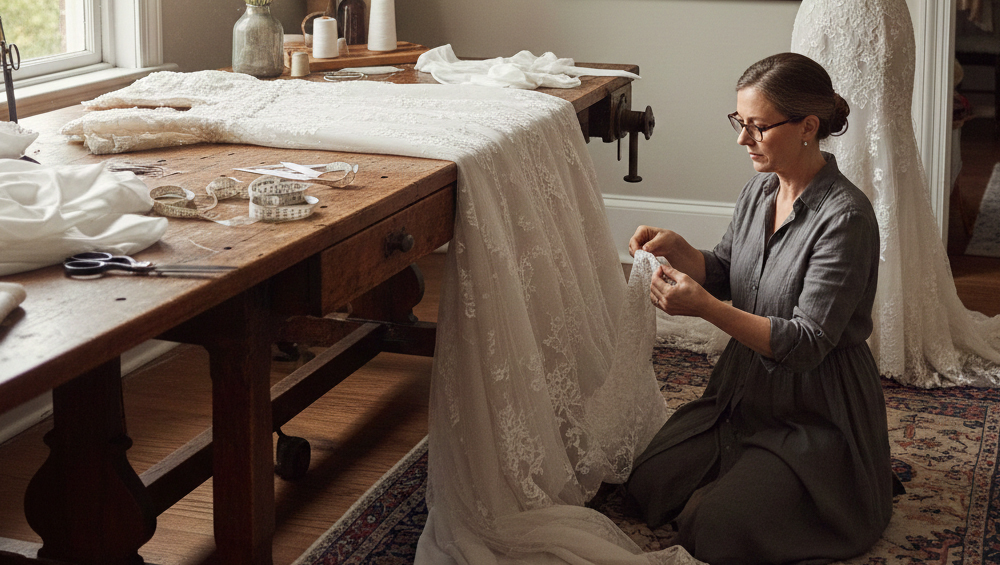
A bride arrived with a designer gown that needed to be taken in slightly at the waist — a job she’d already brought to a general alteration shop first, since it seemed straightforward. That shop had machine-stitched directly along the side seam, right through the edge of a hand-appliquéd lace motif that ran across the bodice. By the time she came to us, several lace petals had torn along the new stitch line, and the machine tension had puckered the surrounding tulle so it no longer sat flat.
Our team had to carefully unpick the machine stitching first — itself a delicate task, since pulling too hard risks tearing the lace further — then hand-tack the lace motifs back into their original position before rebuilding the seam using a technique that keeps stitching hidden beneath the appliqué rather than through it. The waist came in as requested, but the extra step of repairing the earlier damage added real time and cost that could have been avoided entirely.
What Actually Separates a Bridal Specialist From a General Tailor
Most tailors are genuinely skilled at everyday alterations — hemming trousers, taking in a blazer, shortening a skirt. Bridal work draws on a different, narrower set of skills that isn’t part of standard tailoring training:
- Hand-finishing around appliqué and beading — knowing when a machine simply shouldn’t touch a seam at all
- Reading factory construction in reverse — understanding how a gown was originally assembled well enough to take it apart and put it back together the same way
- Working with bridal-specific fabrics — silk organza, tulle, duchess satin, and beaded lace all behave differently under a needle than everyday fabrics do
- Balancing a train’s weight — knowing how fabric further down the skirt pulls on the bodice once the dress is worn, not just how it looks laid flat on a table
None of this is intuitive from general sewing experience. It’s learned specifically through repeated hands-on work with bridal garments — which is exactly why “a skilled tailor” and “a qualified bridal specialist” aren’t automatically the same thing.
How to Tell If a Shop Is Actually Qualified for Bridal Work
Before handing over a wedding dress, these questions help separate genuine bridal expertise from general tailoring:
Ask to see examples of bridal-specific work
Photos of hemmed trousers or resized blazers don’t demonstrate bridal experience. Ask specifically for gowns they’ve altered.
Ask how they’d handle lace or beading near the alteration area
A specialist will describe hand-finishing techniques without hesitation. A vague or uncertain answer is a warning sign.
Ask about their experience with your specific fabric
Silk organza, duchess satin, and heavily beaded tulle each require different handling — a shop confident with one isn’t necessarily confident with all of them.
Notice whether they ask to see the dress worn, not just laid flat
A specialist checks how the train and skirt weight behave in motion, not just how the garment looks on a table.
General Tailor, or Bridal Specialist — Which Do You Actually Need?
Not every wedding-dress-related task requires a bridal specialist specifically. Use this framework to decide:
✅ A general tailor may be sufficient
- Simple pressing or steaming with no stitching involved
- Attaching a bustle loop with no lace or beading nearby
- A plain, single-layer dress with no embellishment
- You’ve confirmed they’ve handled bridal fabric specifically before
⚠️ A bridal specialist only
- Any seam near hand-appliquéd lace, beading, or embroidery
- Adjusting a bodice with boning or a structured lining
- A train, layered skirt, or anything affecting how weight hangs when worn
- Silk organza, duchess satin, or other bridal-specific fabric
A simple rule that always applies: if the work is anywhere near embellishment, structure, or bridal-specific fabric, confirm real bridal experience before approving the job — not just general tailoring skill.
What Goes Wrong When a Non-Specialist Takes On Bridal Work
Even a skilled general tailor, working outside their area of experience, tends to produce the same recurring problems:
- Machine stitching through delicate lace or beading, tearing or loosening it
- Seams that look fine laid flat but pull or gape once the dress is worn with its full weight
- Bridal fabric puckering or snagging under standard sewing tension settings
- Repairs that then require a specialist to undo before the original request can even be addressed
“Being good with a needle and thread isn’t the same as knowing bridal construction. One is a skill; the other is a specialty.” — Mallika Thaidress
How Our Bridal Specialists Are Trained
At Mallika ThaiDress, bridal alteration isn’t treated as an extension of general tailoring — it’s its own discipline. Before a team member works on a client’s gown independently, we require:
Direct experience with lace, beading, and appliqué
Hands-on repetition with hand-finishing techniques, not just familiarity from observation.
Practice with bridal-specific fabrics
Working directly with silk organza, duchess satin, and structured tulle until their behavior under a needle is second nature.
Fitting assessment with the garment worn, not just laid flat
Confirming how weight and balance behave in motion before finalizing any structural change.
Sign-off from a senior specialist before independent bridal work
No one alters a client’s wedding dress solo until this level of trust has been earned within the team.
Mallika Thaidress’s Decision-Making Principle
Mallika Thaidress holds that garment alteration work should not begin with the question “can this be altered?” alone, but must start by assessing “would this alteration be safe for the structure, materials, silhouette, and value of the garment?”
When the risk of an alteration outweighs its benefit, recommending against it — or pausing to assess further — is just as much a part of professional standards as carrying out the work itself.
Wedding Dresses and Specialist Alteration — Frequently Asked Questions
Can’t any experienced tailor handle a simple wedding dress alteration?
Not always. General tailoring skill and bridal-specific expertise are different things — bridal work involves hand-finishing, delicate fabrics, and structural elements that aren’t part of everyday tailoring training.
How do I know if a shop has real bridal experience?
Ask to see gowns they’ve specifically altered, ask how they’d approach lace or beading near your alteration, and confirm their experience with your dress’s specific fabric.
What’s the risk of using a general alteration shop for a wedding dress?
Common problems include machine stitching damaging lace or beading, seams that look fine flat but fail once the dress is worn, and fabric puckering from incorrect tension settings.
If a general tailor already started the alteration, can a specialist still fix it?
Often yes, but it typically requires undoing the earlier work first, which adds time and cost beyond what the original alteration would have needed.
What training do bridal specialists actually go through?
Direct, repeated hands-on work with lace, beading, and bridal-specific fabrics, plus fitting assessment with the garment worn — not just observation or general sewing experience.
Not Sure If Your Shop
Has Real Bridal Experience?
Send us photos of your dress for a free assessment. We’ll tell you honestly what the alteration involves, and what kind of experience it actually requires.
📌 Woon Khiaozen Designer
Free consultation on garment repair and alteration · We reply every day