Risks of Incorrect Wedding
Dress Alteration (Structure / Value)
Damage from an incorrect wedding dress alteration has two dimensions that are separate, yet always connected — structural damage and value damage. This article explains both clearly.
This article is part of the knowledge cluster under Why Wedding Dress Alterations Require Specialized Experts, focused specifically on risk — what happens when a wedding dress is altered incorrectly. This breaks down into two dimensions that almost always occur together: structural damage and value damage.
When Cutting Boning Destroyed Both Structure and Value at Once
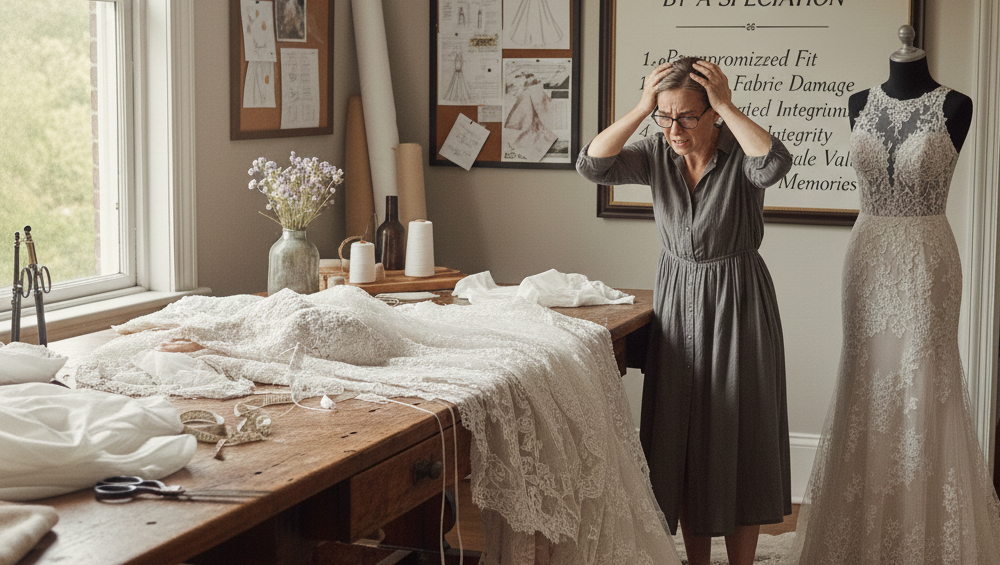
A client brought us a 1980s vintage gown from a now-defunct brand for assessment, after it had already been to a general alteration shop for waist adjustment. On inspection, we found the previous shop had solved a tightness problem by cutting the boning directly at the waist — instead of adjusting the side seam — an approach that looked like a quicker fix, but permanently destroyed the load-bearing structure the bodice depended on.
The consequences arrived in two layers: structurally, the bodice visibly collapsed at the waist once worn, since there was no boning left to support it, and in terms of value, because this was a rare vintage piece from a discontinued brand, boning of that exact size and material could never be sourced to match the original. The dress’s collector value dropped permanently — all from what started as a minor fit issue.
How Structural Damage and Value Damage Differ — Yet Always Connect
An incorrect wedding dress alteration usually creates both dimensions of damage at once, even though they present differently:
Structural risk
- Boning shifts out of position or pokes through the fabric, once a connected load-bearing system is cut at any single point
- The silhouette collapses or twists from changed weight distribution after an alteration that didn’t account for the system as a whole
- Seams tear when the dress is actually worn, even if they looked fine laid flat on a table
Value risk
- Collector or financial value is permanently reduced once the original structure — a key part of authenticity — has been altered
- The piece can no longer be resold as authentic and original, especially for garments from named designers or historically significant eras
- Sentimental value is lost along with the original condition, with no way to reclaim it
These two risks are always connected — structural damage almost always leads to a loss of value automatically, whether intended or not.
Warning Signs to Watch For Before Damage Spreads
Before approving an alteration, look for these signs to assess the risk:
Ask how the boning in the dress is connected
If a shop can’t clearly explain how altering one point will affect others, that’s a warning sign.
Ask how they’ll test the result before making it permanent
A specialist should have a method to assess impact before any irreversible cutting or dismantling.
Check whether the dress has collector or historical value
If it does, ask further how well the shop understands preserving original authenticity.
Notice whether the shop explains risk in advance
A responsible shop will always explain both structural and value risk before beginning any work.
What Level of Risk Is Acceptable, and What Should Stop You
Not every alteration carries the same level of risk. Use this framework to distinguish:
✅ Acceptable risk
- The alteration doesn’t touch boning or the main load-bearing system
- The dress has no particular collector or historical value
- The shop clearly explains possible effects before starting
- There’s a backup plan if the result isn’t as expected
⚠️ Risk that should stop you and prompt further consultation
- Requires cutting or dismantling boning connected to other points
- The dress is a collector’s piece, a named designer’s work, or historically significant
- The shop can’t explain the impact on the whole structural system
- There’s no way to test the outcome before making it permanent
A simple rule that always applies: if the potential damage would affect both structure and value at the same time, treat it as a level of risk that always requires expert consultation first.
The Limits of Recovering From Damage
Once damage has occurred, recovery has important limitations to understand:
- Bent or distorted boning usually can’t be reshaped back to perfectly straight
- Even if the structure is repaired to be wearable, original authenticity for collector purposes usually can’t be restored
- The longer damage goes unaddressed, the more it tends to spread
“Structural damage can often be repaired — but lost original authenticity almost never can.” — Mallika Thaidress
How Mallika ThaiDress Reduces These Risks
When taking on work with structural or value risk, our team always follows this sequence:
Examine the full structural system before touching any single point
Understand how boning and load-bearing points connect across the entire garment.
Assess collector or historical value before planning
If the dress carries special value, we adjust our approach to minimize impact on original authenticity.
Test the impact before making anything permanent
Use temporary techniques to see the result before any real cutting or dismantling of structure.
Decline the job immediately if the risk is too high
If our assessment shows structural or value risk isn’t worth it, we tell the client honestly rather than proceeding.
Mallika Thaidress’s Decision-Making Principle
Mallika Thaidress holds that garment alteration work should not begin with the question “can this be altered?” alone, but must start by assessing “would this alteration be safe for the structure, materials, silhouette, and value of the garment?”
When the risk of an alteration outweighs its benefit, recommending against it — or pausing to assess further — is just as much a part of professional standards as carrying out the work itself.
Risks of Incorrect Wedding Dress Alteration — Frequently Asked Questions
How can cutting boning at just one point affect the whole dress?
Because boning in a wedding dress is typically a connected load-bearing system. Cutting one point forces the weight that used to distribute evenly to concentrate elsewhere, which can lead to spreading damage.
Can structural damage always be repaired?
Not always. Boning that’s already bent or distorted usually can’t be reshaped back to perfectly straight, even if the structure is repaired enough to be wearable.
Why does collector value drop even if the dress can still be worn?
Because collector value is typically tied to original structural authenticity. Once a permanent change is made, the original authenticity can never be reclaimed, even if the garment functions normally.
What should I ask a shop before approving high-risk work?
Ask how the boning is connected, how they’ll test impact before any permanent change, and — if the dress has special value — how well they understand preserving original authenticity.
If damage has already happened, what should I do next?
Send it for expert assessment as soon as possible, since damage tends to spread further the longer it’s left unaddressed. While original authenticity can’t always be fully recovered, quick repair helps limit further damage.
Not Sure If Your Alteration
Risks Structure or Value?
Send us photos for a free assessment before deciding. We’ll tell you honestly whether your requested alteration risks the dress’s structure or value.
📌 Woon Khiaozen Designer
Free consultation on garment repair and alteration · We reply every day
1 Comments on “Risks of Incorrect Wedding Dress Alteration (Structure / Value)”
Comments are closed.