Specialized Techniques
to Preserve the Original Design
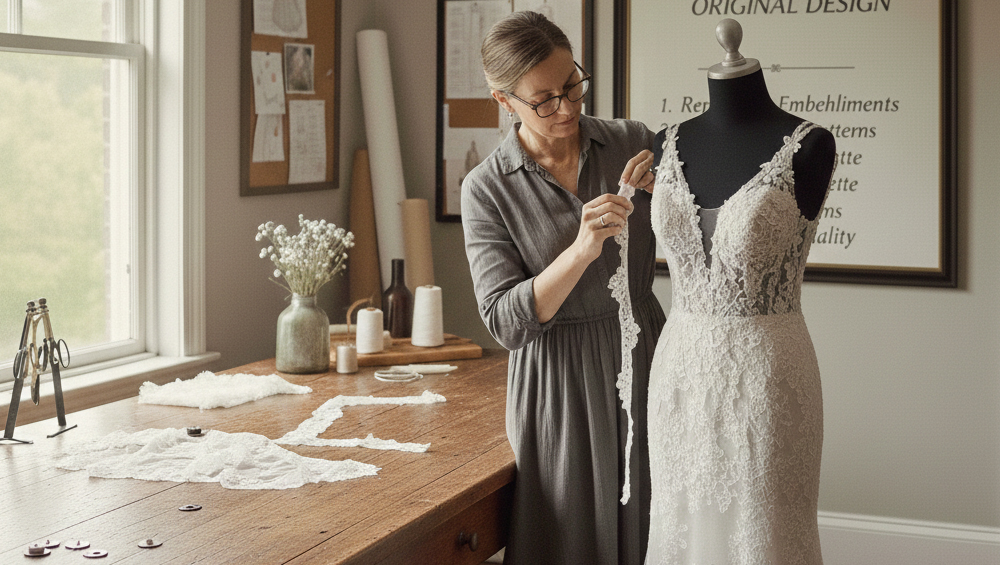
A good alteration isn’t just about fit — it’s about keeping the designer’s original lines and proportions as intact as possible, so intact that even a close look barely reveals any trace of the work.
This article is part of the knowledge cluster under How to Alter a Wedding Dress Without Ruining Its Structure. If the earlier article covered preserving tangible “structure” like boning and lining, this one goes deeper into something more delicate: the visible lines and proportions that are the heart of the original design.
When Taking In the Wrong Seam Almost Threw Princess Lines Off Balance
A bride brought in a gown with princess seams curving from shoulder to waist on both the front and back, asking for the waist to be taken in. Princess seams are the main design lines defining the entire garment’s proportions. Taking in that seam directly — the option that seemed simplest to her — would have immediately thrown the previously symmetrical curve out of balance, since it’s the most visually prominent line on the entire dress.
Our team instead chose to alter the side seam, hidden beneath the arm, calculating the exact amount needed to achieve the fit she wanted without touching the princess lines at the heart of the design at all. The result was a genuinely more fitted gown, with the designer’s lines remaining as symmetrical and beautiful as the day it left the atelier.
Techniques Used to Preserve the Original Design Lines
Haute couture has long developed specialized techniques to leave alterations nearly invisible (see general background on haute couture for further reading), and our team applies these principles to wedding dress alterations:
- Hidden Seam Selection — choosing to alter the least visible seam, rather than the main lines that define the design’s identity
- Blind Stitching — a hand-sewing technique that leaves the new seam line nearly invisible from the outside, unlike machine stitching, which usually leaves a more obvious trace
- Thread & Tension Matching — choosing thread color and weight to match the original production, and adjusting machine tension as closely as possible
- Dart Relocation — when the fit needs adjusting, relocating a dart to the point with the least impact on overall design lines, rather than simply enlarging the original dart
The shared principle behind all of these techniques: the result should look as if the dress was designed to fit this way from the start, not altered afterward.
How to Identify a Design’s Key Lines Before Planning an Alteration
Before choosing where to alter, analyze in this sequence:
Look for the seam lines that define the design
Notice which seam lines create the garment’s shape or visual identity — such as princess seams, neckline curves, or lace positioned along a seam.
Identify hidden or hard-to-see seams
Such as the side seam under the arm, or the back seam under the zipper — points that are usually alterable without catching the eye.
Assess whether a hidden seam alone gives the result needed
Sometimes one hidden point isn’t enough, and the alteration needs to be spread across several small points so no single one carries too much of the change.
Compare thread samples and technique against the real fabric
Test whether the thread color and tension chosen blend with the original stitching, before touching the actual garment.
What Affects the Design, and What Doesn’t
Use this framework to assess how much an alteration point would affect the design’s lines:
✅ Can be altered without affecting the design
- The alteration point is a hidden seam, such as the side or back under the zipper
- It doesn’t cut through main design lines like a princess seam or lace pattern
- Fabric and technique are available that closely match the original production
- The amount to adjust falls within what a hidden point can accommodate
⚠️ Risks affecting the design, needs special planning
- The alteration point directly overlaps a main design line
- The amount to adjust exceeds what a single hidden point can accommodate
- No fabric or technique is available that matches closely enough
- The design has specific details (like precisely positioned lace) that are hard to avoid
A simple rule that always applies: when there’s a choice between altering a main design line or a hidden seam, always choose the hidden seam — even if it takes longer to calculate.
What Happens When an Alteration Ignores the Design Lines
An alteration that overlooks the original design lines often creates problems clearly visible when the dress is seen as a whole:
- Previously symmetrical lines skew to one side, noticeable immediately from a distance
- The garment’s proportions shift away from what the designer originally intended
- New stitching leaves a visible trace, breaking the “flawless” feel of couture work
- In some cases, the entire alteration must be undone and replanned from scratch — costing far more time and money than planning correctly from the start
“The best alteration is the one that looks like it was never altered at all.” — Mallika Thaidress
Mallika ThaiDress’s Process for Preserving the Original Design
When altering a dress with clear design lines, our team always follows this sequence:
Map the garment’s design lines before planning
Identify which seams, lace, or details are the heart of the design, that must be avoided touching directly.
Choose the best hidden point for the alteration
Calculate which hidden point can accommodate the full amount needed, without touching the main design lines.
Use hand-sewing technique at points requiring maximum smoothness
Choose blind stitching over machine sewing wherever the result needs to leave virtually no visible trace.
Check the overall lines before delivery
View the dress from both a distance and up close, to confirm proportions and design lines remain as symmetrical and beautiful as the original.
Mallika Thaidress’s Decision-Making Principle
Mallika Thaidress holds that garment alteration work should not begin with the question “can this be altered?” alone, but must start by assessing “would this alteration be safe for the structure, materials, silhouette, and value of the garment?”
When the risk of an alteration outweighs its benefit, recommending against it — or pausing to assess further — is just as much a part of professional standards as carrying out the work itself.
Specialized Techniques to Preserve the Original Design — Frequently Asked Questions
Why is taking in the waist at a princess seam riskier than at a side seam?
Because princess seams are the most visually prominent design lines, defining the entire garment’s proportions. Even a small adjustment there can immediately throw a previously symmetrical curve out of balance, unlike a side seam hidden under the arm.
How does hand sewing differ from machine sewing in terms of smoothness?
Blind stitching leaves the new seam line nearly invisible from the outside, while machine stitching usually leaves a more noticeable trace, especially on thin or shiny fabric.
What if one hidden point isn’t enough for the amount that needs adjusting?
Our team spreads the alteration across several small hidden points instead of letting any single one carry the full load, reducing risk to the overall design lines.
Why does matching thread matter?
Thread color or weight that doesn’t match the original production makes the altered point stand out clearly against the rest of the garment. Precise matching helps the alteration blend seamlessly with the whole dress.
What if the design has precisely positioned lace that’s unavoidable?
An in-person assessment is needed to plan specially — this may involve temporarily removing the lace and hand-stitching it back into its exact original position, rather than altering the seam directly through it.
Want an Alteration That
No One Can Tell Was Made?
Send us photos for a free assessment before deciding. We’ll plan the alteration point to preserve your dress’s original design lines as fully as possible.
📌 Woon Khiaozen Designer
Free consultation on garment repair and alteration · We reply every day
1 Comments on “Specialized Techniques to Preserve the Original Design”
Comments are closed.