Safe Scope of Wedding
Dress Alteration Work
A job can still qualify as “alteration” by definition and not automatically be safe. A dress’s structure has its own limits that must be respected, however minor a request sounds.
This article is part of the knowledge cluster under The Limits of Wedding Dress Alterations — What Can Be Done, What Shouldn’t Be Done. The parent article explained when a request crosses from “alteration” into “building new”; this one goes deeper into an equally important dimension — even when work still qualifies as alteration, there’s a structural safety limit that must be respected separately.
When “Just Take It In” Had a Limit That Had to Be Respected
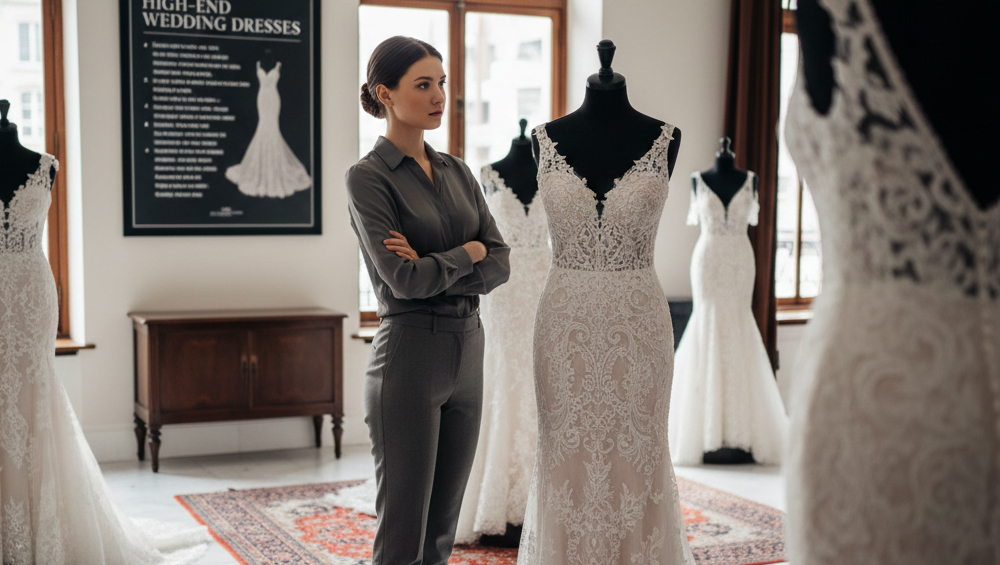
A client wanted the bodice of a strapless wedding dress taken in several sizes, following sudden weight loss before the wedding. This request fell clearly under “alteration” by definition, since it didn’t change the dress’s silhouette or base pattern.
However, when our team examined the structure, we found that taking the bodice in beyond a certain point would affect the boning channel responsible for carrying weight and supporting the dress’s shape. By definition, this work was still “alteration” — but structurally, there was a limit that shouldn’t be crossed. Our team recommended the maximum safe reduction and suggested using another method to close the remaining gap, rather than pushing the alteration past the structural limit — a clear example that “alteration” and “safe” aren’t always the same thing. Work can still qualify as alteration by definition while carrying a separate safety limit that must be respected.
Why Alteration Work Still Has Its Own Safety Limits
The concept of a factor of safety (see general background on factor of safety for further reading) helps explain why work that still qualifies as “alteration” by definition still has limits separate from the question “can this be altered?”:
- Load-bearing elements have their own limits, regardless of work category — whether or not the work is called alteration, a point that carries the dress’s main structural weight has a fixed material limit; crossing it risks damage
- The safe percentage of adjustment differs by point on the dress — some points, like a hemline, can be adjusted at a higher proportion than points with reinforcement structure, like a bodice with boning
- A safety margin isn’t an estimate — it’s calculated from the actual material — different materials have different elasticity and limits; setting a safe boundary must be based on the actual material of that specific dress, not a fixed number applied to every dress
- Falling within the definition doesn’t guarantee a safe result — work may still qualify as “alteration” by definition, yet the result may not be structurally safe long-term if it exceeds the material’s limit
This understanding shows that the correct question isn’t just “does this qualify as alteration?” but also “does this alteration fall within the structure’s safe boundary?”
How to Check Whether Your Alteration Falls Within a Safe Boundary
Before proceeding with a resize or alteration, check in this sequence:
Identify whether the alteration point has reinforcement or load-bearing structure
Check whether that area has boning, lining, or reinforcement material carrying structural load.
Assess the proportion of adjustment requested against the original size
The higher the adjustment proportion, the more thoroughly its impact on structure needs consideration.
Have a specialist test the actual material’s limit before proceeding fully
Don’t infer the limit from general experience — examine the specific material and structure of that dress.
Prepare a backup option in case the full adjustment isn’t safe
Think ahead about how to compensate for any remaining gap if the adjustment can’t be done fully as requested.
When Full Adjustment Is Appropriate, and When to Stop at the Safe Boundary
Use this framework to decide whether to proceed fully or stop early:
✅ Safe to adjust fully as requested
- The adjustment point has no main reinforcement or load-bearing structure
- The adjustment proportion is comfortably within what the material supports
- Examination of the actual material confirms structural strength isn’t affected
⚠️ Must stop at the safe boundary, even if short of the full request
- The adjustment point has boning or reinforcement material carrying load
- The adjustment proportion is high enough to approach the material’s limit
- Further adjustment would affect the supporting structure’s function
- No confirmed information exists that the material safely supports the requested level
A simple rule that always applies: when a full adjustment risks load-bearing structure, always stop at the maximum safe boundary, even short of the full request, and offer another option to compensate rather than forcing it through.
What Happens When an Adjustment Is Forced Past the Structure’s Safe Boundary
Trying to fully meet a request without regard for structural limits usually leads to problems more severe than expected:
- Reinforcement structure forced beyond its limit may fail or lose shape when actually worn, even if it looks fine while off the body
- Problems may not appear right after the alteration, but only show once the dress is actually worn — potentially too late to fix
- Discomfort or a distorted shape from a structure pushed past its limit can directly affect the wearing experience on the important day
- In severe cases, damage from exceeding the limit may not be undoable at all, even though the work still qualifies as “alteration” by definition
“Falling within the definition of “alteration” doesn’t always mean it’s safe.” — Mallika Thaidress
Mallika ThaiDress’s Standard for Setting Safe Boundaries
When taking on a resize or alteration with a high adjustment proportion, our team always follows this sequence:
Always examine the load-bearing structure of the alteration point first
Identify whether that point has boning or reinforcement material that needs special consideration.
Calculate the safe boundary from the dress’s actual material
Never use a fixed number from general experience — assess based on the genuine material characteristics of the dress being altered.
Stop at the safe boundary, even short of the full request
Prioritize structural safety over fully meeting the request when the two conflict.
Honestly offer another option to compensate for any remaining gap
Explain the technical reasoning to the client, and offer an alternative that addresses their need without forcing the structure.
Mallika Thaidress’s Decision-Making Principle
Mallika Thaidress holds that garment alteration work should not begin with the question “can this be altered?” alone, but must start by assessing “would this alteration be safe for the structure, materials, silhouette, and value of the garment?”
When the risk of an alteration outweighs its benefit, recommending against it — or pausing to assess further — is just as much a part of professional standards as carrying out the work itself.
Safe Scope of Wedding Dress Alteration Work — Frequently Asked Questions
Why isn’t work classified as “alteration” always safe?
Because “alteration” is a definition saying the work stays within the existing pattern boundary, not changing the base silhouette. It doesn’t guarantee that adjusting to the requested degree is safe for structure — these are two separate dimensions that must each be assessed.
Is the safe boundary the same at every point on a dress?
No. Points with reinforcement or load-bearing structure, like a boned bodice, usually have a narrower safe boundary than points without reinforcement, like an ordinary hemline.
If a full adjustment isn’t safe, are there other options?
Yes, depending on the dress and the point in question. Options might include a supportive add-on device, or adjusting elsewhere to compensate for the remaining gap. A specialist should present options suited to that specific dress’s situation.
How do you know when the safety limit has been reached?
It requires a specialist to examine the actual structure and material of the dress. There’s no fixed number that applies to every dress, since it depends on the specific material, construction technique, and condition of that piece.
If a shop agrees to a full adjustment without mentioning any limit at all, should I be concerned?
Ask further whether the shop examined structure and material before agreeing. A shop with clear standards usually explains any limit found and the technical reasoning, rather than agreeing immediately without examination.
Want to Know Whether Your Resize
Request Falls Within a Safe Boundary?
Send us photos for a free assessment before deciding. We examine the actual material’s limit before agreeing to anything, so the result is both what you want and safe.
📌 Woon Khiaozen Designer
Free consultation on garment repair and alteration · We reply every day