
How to Properly Manage
Work That Requires Time
Accepting each step’s minimum time doesn’t mean sitting idle waiting. Smart sequencing can shorten total time without rushing a single step.
This article is part of the knowledge cluster under Why Some Alteration Work Should Never Be Rushed. Earlier articles covered why minimum time can’t be rushed and how it affects quality; this one goes deeper into how to plan the sequence of multi-step, time-dependent work as efficiently as possible — without forcing a rush on even a single step.
When a Vintage Gown Needed Three Steps, Each With Its Own Minimum Time
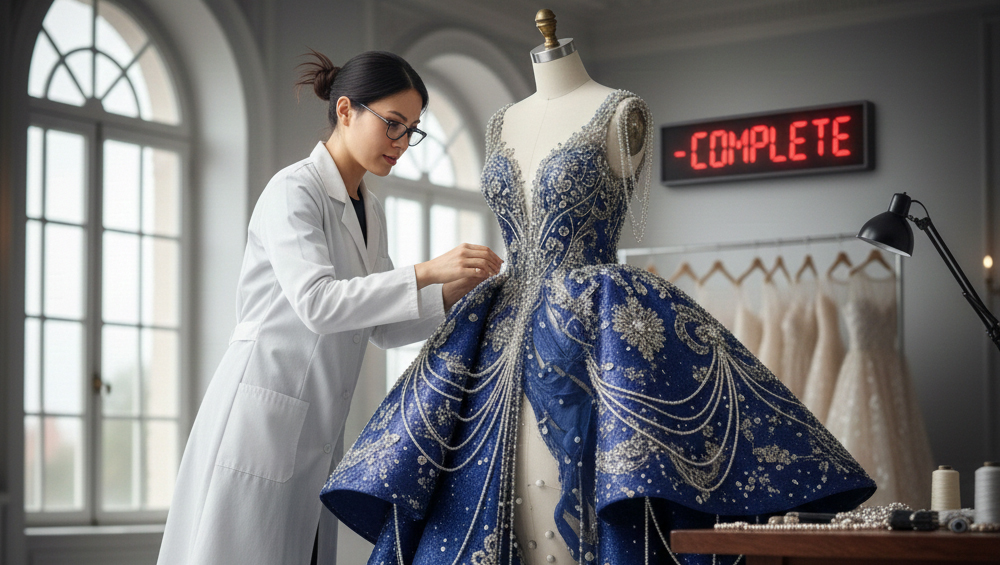
A client brought in a vintage evening gown for a major restoration, requiring three separate steps that each had their own minimum time: color touch-up on faded areas needed time for the dye to absorb and dry completely, reattaching loose embroidered appliqué needed time for the adhesive to set, and repairing a damaged boning channel needed careful, unhurried hand-sewing. If done one step at a time in the usual sequence, the total time would have far exceeded what the client expected.
Our team instead planned a new sequence by identifying which steps could run in parallel across different areas of the same garment: while color dried and set on the skirt, our team could simultaneously repair the boning channel at the waist, a completely separate point. And while adhesive securing the appliqué on the bodice set, our team could prepare materials for the next step at another point. The result was the gown finishing far sooner than the client expected, without a single step being rushed enough to affect quality — because our team managed time intelligently, rather than rushing the work hastily.
Principles for Sequencing Work With Multiple Minimum-Time Points
Workflow-planning principles (see general background on workflow for further reading) can be applied effectively to alteration work with several time-dependent steps:
- Identify which steps can run in parallel — if steps are in different areas of the piece and don’t affect each other, they can be done simultaneously instead of waiting for one to finish first
- Separate steps that must be strictly sequential — some steps genuinely must wait for a previous step to fully complete before starting; identify these clearly, separate from steps that can run in parallel
- Use one step’s waiting time for another step — while material is setting at one point, prep work or another step at an unrelated point can proceed
- Plan the whole workflow before starting real work — calculate the optimal sequence in advance, rather than deciding step by step during the work
This principle lets the total time for the whole project genuinely shorten, without a single step being rushed against its necessary minimum time — the key difference is managing time intelligently, not rushing it.
How to Assess Whether Your Work Can Be Planned in Parallel
Before planning a sequence, check in this order:
List every required step with each one’s minimum time
Build a complete list first, to see the full picture of how long each step takes.
Check which steps are in different areas of the piece
Steps at different points on the garment usually have more opportunity to run in parallel than steps overlapping the same area.
Check which steps genuinely need a result from a previous step
Some steps, even in different areas, still need a result from another step first — for example, needing to know the final color before choosing matching embroidery thread.
Have a specialist plan the full workflow before starting
Don’t decide the sequence as you go — plan everything in advance to use total time as efficiently as possible.
Safe to Run in Parallel, or Should Be Strictly Sequential
Use this framework to distinguish steps safe to run in parallel from steps that must wait in sequence:
✅ Safe to run in parallel
- Steps are in different, unconnected areas of the piece
- One step’s result doesn’t affect the decision for another step
- Materials or techniques used don’t physically interfere with each other
⚠️ Should be strictly sequential
- The next step depends on a previous step’s result, such as final color or adjusted size
- Work areas overlap enough to physically interfere with each other
- The technique used carries high risk requiring full concentration without interruption from another task
A simple rule that always applies: if you’re unsure whether two steps are connected, treat them as sequential for safety, because a mistaken parallel plan can create preventable damage.
What Happens When Sequencing Is Planned Wrong
Incorrect sequencing — whether running the wrong steps in parallel or not planning at all — usually leads to problems:
- Running steps in parallel at a point that should have waited for a result first can require rework when the following result doesn’t match what was already done
- Working in overlapping areas carelessly may let material or technique from one step unintentionally interfere with another
- Not planning ahead at all and deciding along the way usually wastes more total time than it should
- In the worst case, incorrect sequencing may require restarting a step entirely, which costs far more time than planning correctly from the start
“Good time management isn’t shortening the time — it’s making the fullest use of the time you have.” — Mallika Thaidress
Mallika ThaiDress’s Standard for Sequencing Work
When taking on work with several time-dependent steps, our team always follows this sequence:
Map every step with its minimum time before real work begins
Identify every step, each one’s minimum time, and the relationships between steps clearly.
Group steps that can run in parallel by area and relationship
Plan which steps can safely run simultaneously without affecting the quality of any of them.
Calculate the shortest realistic total timeline without rushing any step
Use the step map to calculate the genuinely achievable total time, then tell the client an accurate deadline.
Adjust the plan immediately if a step needs more time during real work
If any step is found to need more time than estimated during the work, adjust the remaining plan immediately rather than forcing the original deadline.
Mallika Thaidress’s Decision-Making Principle
Mallika Thaidress holds that garment alteration work should not begin with the question “can this be altered?” alone, but must start by assessing “would this alteration be safe for the structure, materials, silhouette, and value of the garment?”
When the risk of an alteration outweighs its benefit, recommending against it — or pausing to assess further — is just as much a part of professional standards as carrying out the work itself.
How to Properly Manage Work That Requires Time — Frequently Asked Questions
Does working on several parallel points at once affect the tailor’s focus?
Not if planned correctly. Parallel work means switching to another step while material at one point sets naturally on its own — it’s not truly doing several things simultaneously at the exact same moment, which is different from rushing by cutting attention.
How can a client tell if a shop genuinely plans sequencing efficiently?
Ask whether the shop has a clear workflow plan. A shop that plans well can usually explain which steps run in parallel with which, and why the sequence was set that way.
Can every job always be planned in parallel to reduce time?
Not always. Work with a single step, or steps entirely dependent on each other in sequence, may have no opportunity for parallel planning at all. Parallel planning suits work with several steps in clearly separate areas.
If the original plan turns out unsuitable during the work, what should happen?
The plan should be adjusted immediately to match the real situation, rather than forcing through an original plan that no longer fits. Communicating with the client about a deadline change is also an important part of this step.
How much time can good sequencing actually save?
It depends on how many steps can run in parallel and each step’s minimum time. In some cases, total time can be significantly reduced without affecting quality anywhere.
Have a Major Restoration
Involving Several Steps?
Send us photos for a free assessment before deciding. We’ll plan a sequence that keeps total time as short as possible without lowering quality anywhere.
📌 Woon Khiaozen Designer
Free consultation on garment repair and alteration · We reply every day
1 Comments on “How to Manage Time-Intensive Alteration Work Properly”
Comments are closed.