

Couture Work Mallika ThaiDress
Has Actually Completed
From theory into real work in a tailor’s hands — examples showing how the couture-level techniques covered in earlier articles were used to solve genuine problems.
This article is part of the knowledge cluster under How Couture-Level Alteration Differs From General Alteration. Earlier articles covered the theoretical differences in materials, technique, and risk; this one shows three real pieces our team has worked on, to illustrate how those principles get applied to solve genuine problems.
When a Fringed Edge Had to Stay Continuous After Resizing
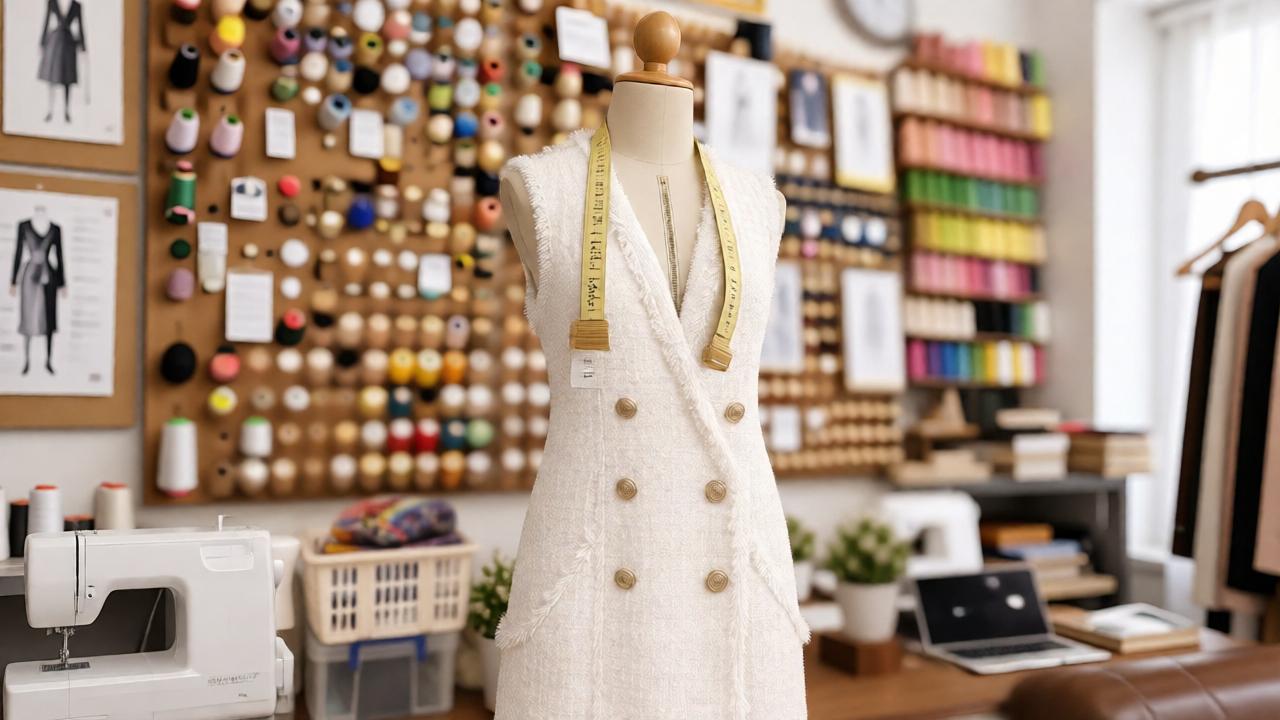
This white double-breasted tweed vest has a fringed edge created by hand-pulling threads from the fabric one at a time, into a continuous fray running all the way around the garment. The client wanted the body taken in at the side seams for a more fitted look. The challenge: cutting straight through fabric where fringe already existed would leave the fringe abruptly cut off and unraveling unevenly on each side, breaking the continuity of hand-craftsmanship that ran around the entire piece.
Our team first had to unpick the fringe at the point being altered, resize the body of the garment as needed, then reattach the fringe edging and pull new threads by hand to blend seamlessly with the original line all the way around. On top of that, taking in the body shifted the spacing between the six gold buttons in the double-breasted layout out of symmetry. Our team had to recalculate the spacing entirely and reposition the buttons so both rows stayed perfectly symmetrical. The result: a genuinely more fitted vest, with the fringed edge still continuous all the way around and the buttons still symmetrical, as if it had never been altered at all.
Real Work Showing the Range of Couture Technique
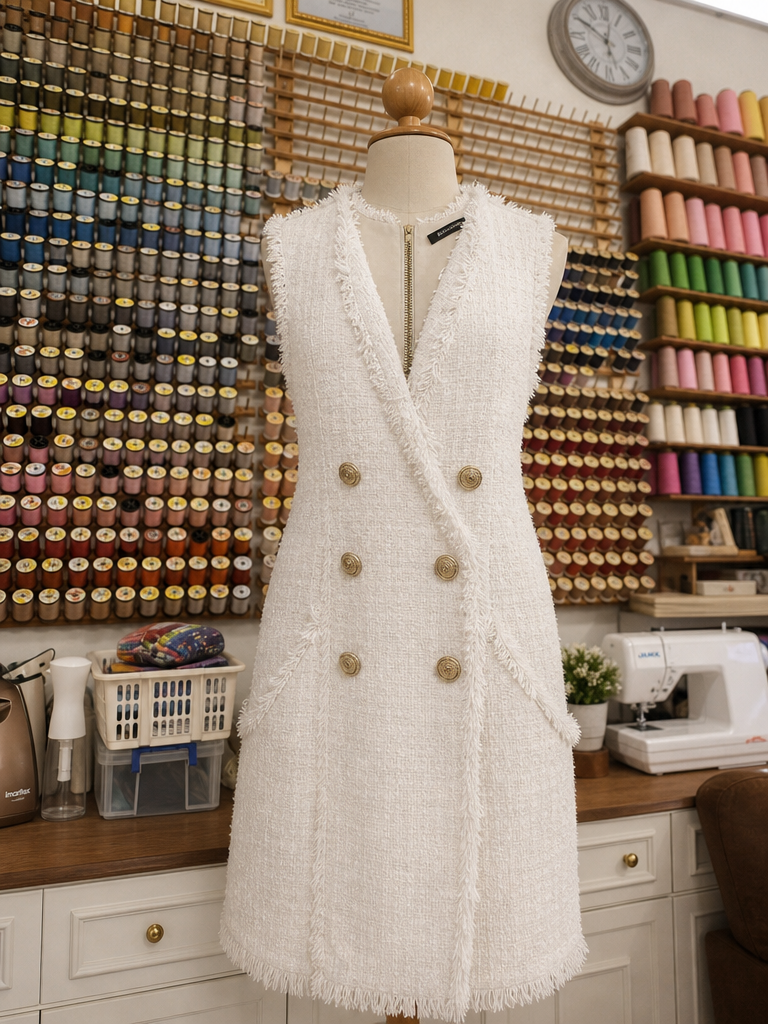
Double-breasted fringed tweed vest — resized while preserving the continuity of a hand-made fringed edge, along with recalculating the position of all six gold buttons for symmetry (the Real Case above).
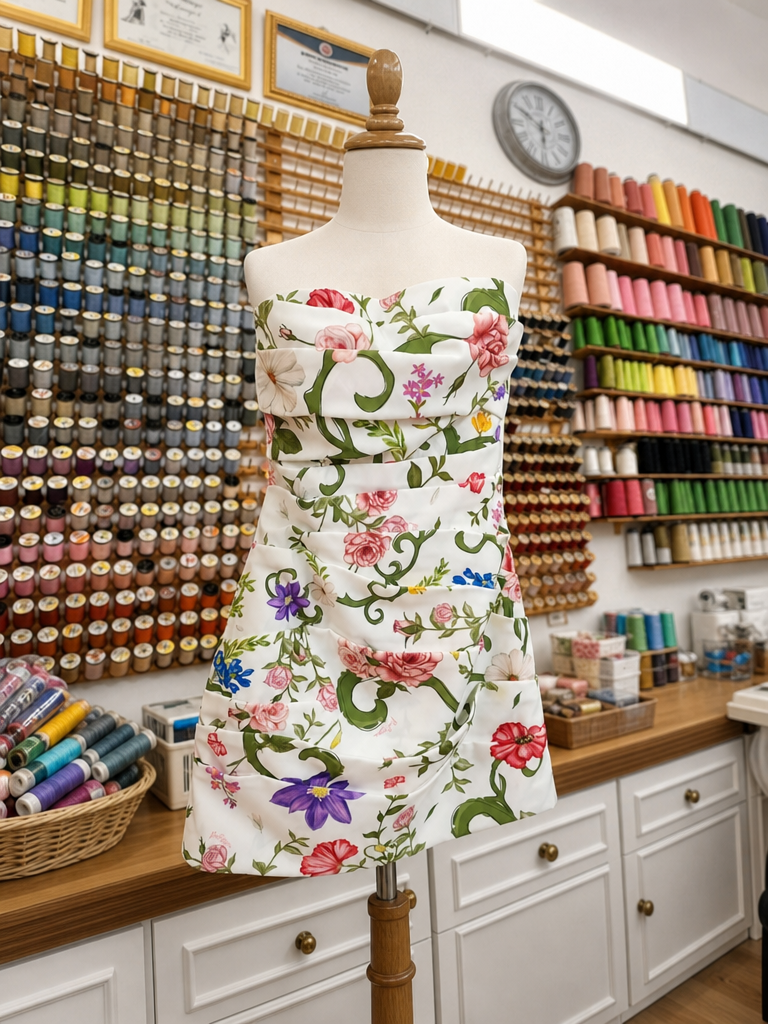
Floral-print ruched cocktail dress — ruching work on printed fabric that had to be calculated so the floral pattern flowed continuously through each fold, never breaking the pattern or accidentally cutting a stem or branch mid-fold. Fold positions had to be planned in advance before any actual sewing.
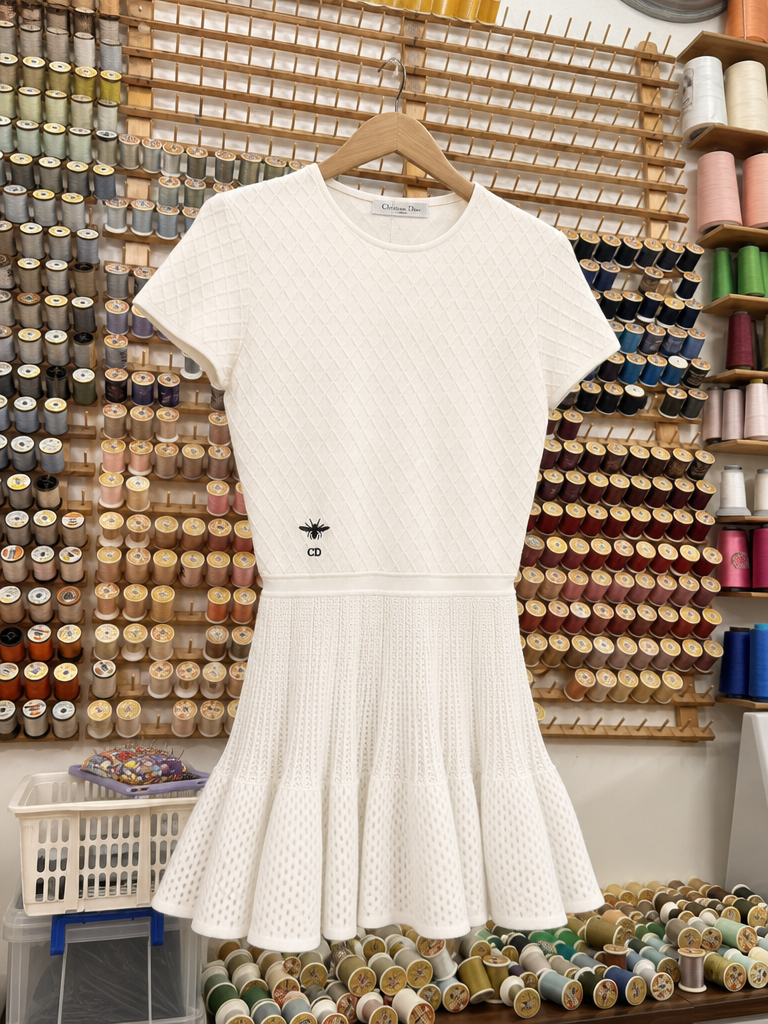
Christian Dior quilted knit dress — care and adjustment work on a designer knit piece with a specialized quilted knit structure and a pleated skirt, requiring the knit’s elasticity to stay even across every point after adjustment, so no single area stretched more than another and threw off the shape.
These three pieces show that couture work isn’t limited to wedding dresses — it extends to everyday wear, evening pieces, and designer garments with specialized structure or pattern as well.
The Specific Techniques Behind Each Piece
Fabric work with patterns or details that run continuously around a garment (see general background on tweed for further reading) requires a different kind of planning than altering plain fabric:
- Hand-pulled fringe — thread must be pulled one strand at a time along the fabric grain, so the fringe’s density and length stay consistent all the way around, unlike factory-made fringe trim attached afterward
- Calculating double-breasted button symmetry — when body width changes, spacing between both rows of buttons must be recalculated to stay equal on each side, not just repositioned by eye
- Pattern matching in printed fabric folds — fold positions must be planned in advance by reading the direction of the printed pattern, so no fold cuts through the middle of a flower stem or breaks the pattern’s flow
- Caring for quilted knit fabric — knit elasticity must stay even at every point after adjustment, since knit stretches more easily than woven fabric and can lose its shape if pulled unevenly
What these techniques share is that the whole piece must be considered before touching any single point — because altering one section in isolation, without accounting for pattern or structural continuity, usually leaves the result looking out of harmony with the rest of the piece.
How to Tell If Your Piece Needs This Kind of Planning
Before deciding what to alter, check in this sequence:
Notice whether a pattern or detail runs continuously around the garment
Such as fringed edging, a directional print, or a repeating quilted pattern — where altering one section in isolation could break the continuity.
Check whether buttons or details need to stay symmetrical
Garments with multiple buttons arranged in a set pattern usually need spacing recalculated every time size is adjusted.
Test fabric elasticity at an inconspicuous point
Especially for knit or specially structured fabric, test in advance how it will stretch or change shape when pulled or adjusted.
Have a specialist assess before deciding, if unsure
Pieces with complex detailing usually need experience to plan before any sewing begins — not just sewing skill alone.
Points Needing Detailed Planning vs. Points That Are Straightforward
Use this framework to assess what level of care your piece needs:
✅ Straightforward to alter
- Plain fabric with no pattern needing directional matching
- No detail needing symmetry, such as a single button or zipper
- No special decorative edging needing continuity
- Standard woven fabric that doesn’t stretch easily
⚠️ Needs detailed planning before starting
- A printed or woven pattern that must flow continuously around the piece
- Multiple buttons or details that need to stay symmetrical
- Hand-made decorative edging, such as fringe or lace
- Knit or specially structured fabric that stretches easily
A simple rule that always applies: if a piece has any element that runs “continuously around” it — whether a pattern, decorative edging, or button placement — always plan the whole layout before touching any single point.
What Happens When Continuity Isn’t Planned For
Altering one point without considering the whole piece often creates problems that are clearly visible when the piece is seen as a whole:
- Fringed or decorative edging cuts off abruptly, breaking the sense of continuous craftsmanship around the whole piece
- Uneven button spacing is clearly visible when the garment is seen from the front
- A printed pattern breaks or is cut mid-stem at fold points, making the pattern look unnatural
- Knit stretches unevenly after adjustment, throwing off the shape and requiring rework, at higher cost than planning correctly the first time
“Good craftsmanship treats the whole piece as one image — not points altered separately from each other.” — Mallika Thaidress
Mallika ThaiDress’s Standard for Planning Continuous Detail
Whenever a job involves a pattern or detail that runs continuously around a piece, our team always follows this sequence:
Photograph and map the whole piece’s details before starting
Chart every pattern, button, or decorative edge position, to see the whole picture before deciding what to alter.
Remove necessary details first, then alter the main structure
Such as unpicking fringe edging before resizing the body, rather than cutting straight through it.
Recalculate positions for symmetry or continuity across the whole piece
Whether button placement, fold lines, or decorative edging, everything must be recalculated to blend with the adjusted structure.
Check continuity all the way around before delivery
View the piece from every angle to confirm pattern, edging, and every detail flow naturally and continuously.
Mallika Thaidress’s Decision-Making Principle
Mallika Thaidress holds that garment alteration work should not begin with the question “can this be altered?” alone, but must start by assessing “would this alteration be safe for the structure, materials, silhouette, and value of the garment?”
When the risk of an alteration outweighs its benefit, recommending against it — or pausing to assess further — is just as much a part of professional standards as carrying out the work itself.
Couture Work Mallika ThaiDress Has Actually Completed — Frequently Asked Questions
Why does an altered fringed edge need new hand-pulled thread instead of attaching pre-made fringe trim?
Because pre-made fringe trim usually has a different density and fiber character from fringe pulled by hand from the original fabric. Attaching pre-made trim instead makes the joining point clearly different from the rest of the piece.
Why does button placement need recalculating every time a garment is resized?
Because when the body’s width changes, the original spacing between buttons is no longer symmetrical. Without recalculating, one side may end up visibly closer together than the other.
How does folding printed fabric differ from folding plain fabric?
Plain fabric can be folded anywhere without affecting the overall look, but printed fabric needs the pattern’s direction checked first, so a fold doesn’t cut through the middle of a flower stem or break the pattern’s flow when viewed from outside.
How does caring for designer knitwear differ from caring for general garments?
Knit has higher elasticity than standard woven fabric. Adjusting one point carelessly can stretch the fabric unevenly, affecting the whole piece’s shape, so elasticity must be tested before deciding to alter.
If my piece has details similar to the examples in this article, what should I do?
We recommend sending photos for our team to assess first, so the whole piece’s detail layout can be planned in advance, rather than altering one point without seeing the full picture.
Have a Piece With Complex Detail
You’d Like Us to Care For?
Send us photos for a free assessment before deciding. We’ll plan the whole piece’s detail layout before any actual alteration begins.
📌 Woon Khiaozen Designer
Free consultation on garment repair and alteration · We reply every day