

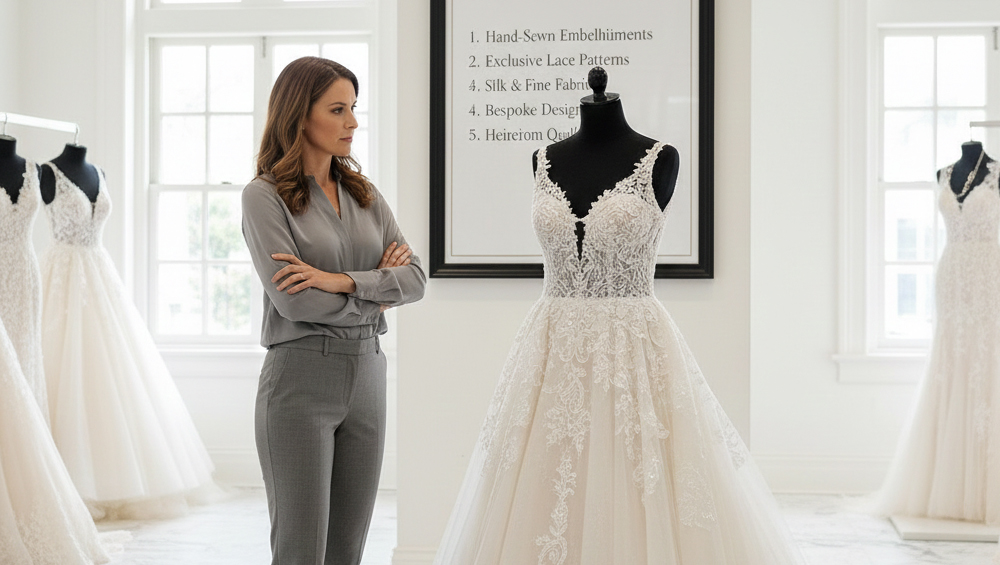
Feasibility Analysis
for Premium Alteration Work
A systematic feasibility assessment before taking on a job catches risk that a surface-level check can miss — before it’s too late to change course.
This article is part of the knowledge cluster under How Incorrect Alterations Damage Expensive Wedding Dresses — the “Easier to Alter” Myth. The previous article explained that complex structure and sentimental value often occur together; this one looks at the systematic feasibility analysis process before taking on premium alteration work — a process that catches risk from the start, rather than running into it midway.
When a Systematic Analysis Caught Risk a Surface Check Would Have Missed
A client brought in a heavily beaded wedding dress needing resizing at both the bodice and skirt, and asked for a quote. Rather than assessing and quoting immediately out of habit, our team ran a systematic feasibility analysis first — examining structural connection points, testing remaining seam allowance, assessing beading density, and checking the dress’s main load-bearing points — before giving the client any answer.
This systematic process revealed that while the skirt could be resized without issue, the bodice had almost no seam allowance left to work with — a structural “point of no return.” A full resize as requested was simply impossible without replacing sections entirely. Because our team had analyzed systematically from the start, we could give an accurate answer and realistic options immediately, rather than discovering halfway through that the bodice couldn’t be resized as promised.
Components of a Systematic Feasibility Analysis
The principle of a feasibility study (see general background on feasibility study for further reading) can be applied effectively to assessing premium alteration work, through the following core components:
- Measure remaining seam allowance directly — not just visually noting that a seam exists, but measuring the actual remaining allowance to assess how much resizing room is left
- Identify the structure’s main load-bearing points — find where the structure carries the most weight or tension, since these points carry the highest risk if altered
- Assess material condition realistically — check whether the material is still in condition to withstand alteration, or fragile enough to require extra caution
- Assess embellishment density — points with dense beading or embroidery usually limit the room available for resizing, requiring an assessment of whether enough clear space exists
This systematic analysis means the answer given is based on genuinely, fully examined data — not a rough estimate from general experience — an important difference that helps prevent promising more than the dress can actually deliver.
Checklist for a Feasibility Analysis Before Taking on Premium Alteration Work
Before agreeing to take on work or giving a quote, check in this sequence:
Measure seam allowance at every point involved in the alteration
Don’t assess by eye alone — measure the actual allowance at every point requiring resizing.
Identify all of the dress’s main load-bearing points
Map where the structure carries the most weight, to know in advance which points carry high risk if altered.
Examine material condition at every relevant point
Assess whether the material is still strong enough for alteration, or shows signs of fragility requiring caution.
Assess embellishment density in the areas needing alteration
Check whether there’s enough room to resize without affecting the embellishment too much.
When a Quick Assessment Is Sufficient, and When a Systematic Analysis Is Needed
Use this framework to decide what level of analysis each job needs:
✅ A quick assessment is sufficient
- The work is a single, uncomplicated, familiar step
- The dress has no dense embellishment or special structure
- The alteration point isn’t near a main load-bearing point
⚠️ A systematic analysis is needed
- The dress carries a high price or sentimental value that makes a mistake costly
- Multiple points need resizing at once on the same dress
- Dense embellishment covers the area needing alteration
- No prior information exists about this brand’s or model’s structure
A simple rule that always applies: the higher the dress’s value or the more complex the scope, the more worth investing time in a systematic analysis, because the cost of analyzing upfront is far less than the cost of preventable damage.
What Happens When the Systematic Analysis Step Is Skipped
Agreeing to work without a systematic feasibility analysis usually leads to problems discovered too late:
- An important point may turn out not to be adjustable as promised, requiring renegotiation with the client after work has already begun
- Discovering a limitation after starting work usually creates more frustration than disclosing it upfront, even when the limitation is a technically unavoidable one
- Forcing through as originally promised when the structure doesn’t support it can lead to damage that was preventable with upfront analysis
- In severe cases, damage from forcing an unsupported alteration point may never be undoable at all
“Time spent analyzing before starting is the time most saved afterward.” — Mallika Thaidress
Mallika ThaiDress’s Standard for Feasibility Analysis
Before taking on any piece of premium alteration work, our team always follows this sequence:
Run the analysis checklist before giving the client any answer
Check seam allowance, load-bearing points, material condition, and embellishment density at every relevant point before quoting.
Record the analysis result as reference for the next steps
Keep the examination findings as documented reference, so planning stays aligned with what was genuinely found.
Tell the client about any limitation found before starting
If a point can’t be adjusted as requested, tell the client immediately with an explanation, before real work begins.
Offer genuinely achievable options rather than over-promising
Present options aligned with the actual analysis, rather than agreeing to what the client wants without an examination.
Mallika Thaidress’s Decision-Making Principle
Mallika Thaidress holds that garment alteration work should not begin with the question “can this be altered?” alone, but must start by assessing “would this alteration be safe for the structure, materials, silhouette, and value of the garment?”
When the risk of an alteration outweighs its benefit, recommending against it — or pausing to assess further — is just as much a part of professional standards as carrying out the work itself.
Feasibility Analysis for Premium Alteration Work — Frequently Asked Questions
How long does a systematic feasibility analysis take?
It depends on the dress’s complexity and the work’s scope, but generally not long compared to the project’s total time, and it helps prevent problems that could take far longer to fix later.
If a shop quotes immediately without a detailed examination, should I be concerned?
For uncomplicated work it may not be an issue, but for a high-value dress or complex scope, ask whether the shop has a thorough structural examination step before quoting.
If the analysis finds a point can’t be adjusted as wanted, are there other options?
In many cases there are other options, such as a partial adjustment instead of a full one, or a substitute technique giving a similar result. A specialist should present these options alongside the limitation found.
How does a systematic analysis differ from an ordinary check?
An ordinary check usually relies on visual inspection and experience, while a systematic analysis uses measurement and a checklist covering every important point, making the result more accurate and complete.
Can a client ask to see the analysis result before deciding?
Yes. A shop with clear standards is usually happy to explain the analysis findings to the client, so they can decide with complete information before work begins.
Have a Premium Dress Needing
Resizing or Complex Alteration?
Send us photos for a free feasibility analysis before deciding. We examine systematically to give you an accurate answer and realistic options from the start.
📌 Woon Khiaozen Designer
Free consultation on garment repair and alteration · We reply every day
2 Comments on “Feasibility Analysis for Premium Alteration Work”
Comments are closed.