

Limitations of
Structural Modification
Not every request is possible within the scope of “alteration.” Knowing what’s genuinely achievable and what exceeds those limits is a core part of working professionally.
This article is part of the knowledge cluster under How to Alter a Wedding Dress Without Ruining Its Structure. Earlier articles explained how to preserve structure and design lines; this one covers something that needs to be stated honestly: some requests exceed the scope of alteration entirely, and knowing that boundary is part of being professional.
When a Client Asked to Turn a Mermaid Gown Into a Ball Gown
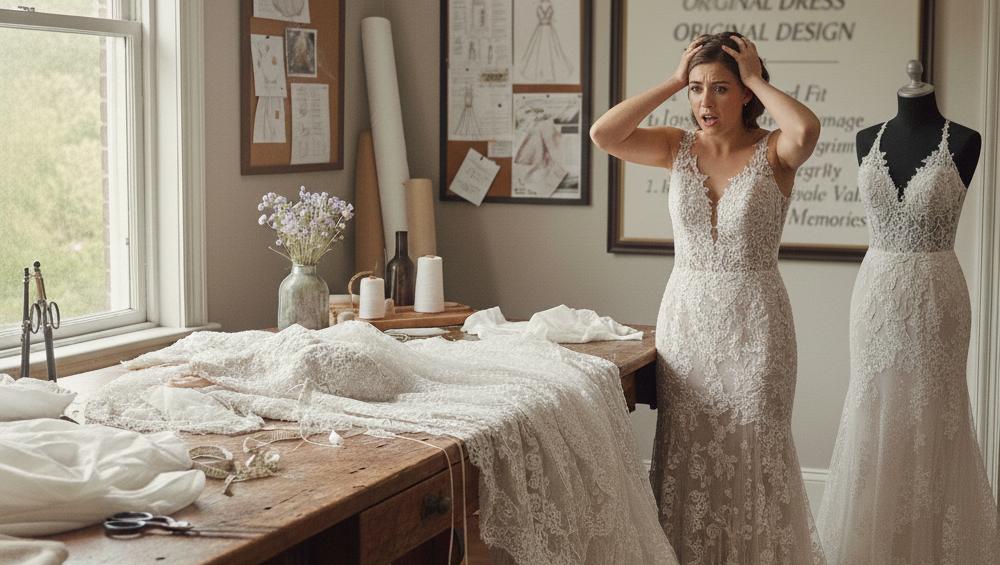
A client brought in a fitted mermaid gown, asking us to add fabric panels at the hemline to flare it out into a ball gown silhouette, reasoning that “just adding fabric should be enough.” On inspection, our team found the original garment’s boning and structured lining had been built specifically for a fitted silhouette from the waist down. Adding fabric to flare it out would require tearing out the entire structure from the waist down and building an entirely new understructure — no longer an “alteration,” but essentially a new garment using some of the original fabric.
On top of that, the gown’s original lace pattern had been discontinued, meaning that even the closest available match could never blend seamlessly into a single piece with the original. Our team explained honestly that what the client wanted exceeded the scope of alteration, and offered a genuinely achievable alternative instead: adding a separate outer tulle layer to create a fuller feel without touching the original structure at all.
Physical Limits That No Alteration Can Overcome
Basic construction principles around seam allowance (see general background on seam allowance for further reading) show the physical limits every alteration runs into, no matter how skilled the tailor:
- A fixed amount of seam allowance — the fabric remaining in a seam is a fixed quantity set at the original construction; no technique can extend it beyond what physically exists
- Discontinued materials with no replacement — a specific-run lace or embroidery pattern the brand has stopped producing can never be sourced as an exact match
- Converting between structural categories — changing from a fitted silhouette to a flared one, or from strapped to strapless, usually requires an entirely different load-bearing system, effectively equivalent to building a new garment rather than altering
- Fabric already stretched or torn beyond limits — fibers damaged past their elastic limit can’t be restored to original condition, even if repaired to be wearable
These limitations have nothing to do with a tailor’s skill or experience — they are genuine physical limits of the materials and structure that actually exist. No technique can change these facts.
How to Assess Whether a Request Exceeds the Scope of Alteration
Before accepting any job, assess in this sequence:
Measure actual remaining seam allowance against what’s needed
Calculate whether the existing seam allowance is genuinely enough for the client’s requested adjustment — a concrete number, not a guess.
Determine whether it’s a size adjustment or a structural category change
Clearly distinguish between fitting adjustments (alteration) and a complete silhouette change (rebuilding), which follow entirely different working principles.
Research whether the fabric or material is still in production
If fabric needs joining or replacing, check in advance whether a close enough match is actually sourceable.
Assess fiber condition at any previously damaged point
Check whether the fabric there still has enough elasticity and strength for further alteration.
Within Scope of Alteration, or Beyond It
Use this framework to distinguish whether a request is genuinely alterable or has exceeded the limit:
✅ Within scope of alteration
- Adjusting size within the original silhouette, with sufficient seam allowance
- No change to the main structural category (e.g., boned to unboned)
- Doesn’t depend on unsourceable replacement materials
- The fabric in the area to be altered is still in normal, strong condition
⚠️ Exceeds scope of alteration, needs alternatives
- Requires converting between entirely different structural categories
- Requires discontinued replacement material that’s no longer sourceable
- The amount needed exceeds the actual remaining seam allowance
- Fiber at a key point is damaged beyond bearing additional load
A simple rule that always applies: if a request depends on materials that don’t actually exist, or a silhouette entirely different from the original structure, treat it as exceeding the scope of alteration — and consider alternatives rather than forcing it through.
What Happens When a Shop Forces Work Beyond Its Limits
When a shop accepts a job exceeding the scope of alteration without disclosing the limitation upfront, the results are often not worth what was spent:
- Mismatched fabric joins remain clearly visible, even after every effort to hide them
- New structure built over the original is usually not as strong as structure designed for the purpose from the start
- Cost and time end up far higher than initially estimated, due to unforeseen complexity
- The final result may not meet the client’s expectations, even after the team’s full effort
“Honesty about limitations matters just as much as skill in alteration.” — Mallika Thaidress
How Mallika ThaiDress Communicates Limitations to Clients
When a request is found to exceed the scope of alteration, our team always follows this sequence:
Explain the limitation with clear technical reasoning
Not just “it can’t be done,” but specifically explaining what’s constrained — seam allowance, material, or a particular structural point.
Offer a genuinely achievable alternative
Find another approach that comes as close as possible to the client’s original goal, within what’s actually achievable.
Decline jobs assessed as not worth the outcome
If every alternative still falls short of what the client genuinely wants, we say so directly rather than accepting work we already know won’t turn out well.
Document the disclosed limitation in writing before work begins
So the client fully understands from the start what limitations the final result will have — no expectations left to guess.
Mallika Thaidress’s Decision-Making Principle
Mallika Thaidress holds that garment alteration work should not begin with the question “can this be altered?” alone, but must start by assessing “would this alteration be safe for the structure, materials, silhouette, and value of the garment?”
When the risk of an alteration outweighs its benefit, recommending against it — or pausing to assess further — is just as much a part of professional standards as carrying out the work itself.
Limitations of Structural Modification — Frequently Asked Questions
Why isn’t converting a mermaid gown to a ball gown just an alteration?
Because the two silhouettes use entirely different load-bearing systems. Converting from fitted to flared requires tearing out the original structure and building an entirely new one — effectively equivalent to constructing a new garment rather than altering.
If a lace pattern has been discontinued, is there a solution?
The closest available match can be sourced as a substitute, but it will never blend 100% seamlessly with the original. Our team always discloses this limitation in advance.
If remaining seam allowance isn’t enough, is there a way to add more?
No technique can create seam allowance that doesn’t physically exist. If the allowance isn’t sufficient for the adjustment, the options are to adjust as much as possible or consider an alternative instead.
If another shop says they can do anything, should I believe them?
Ask for details on how they’d handle physical limitations like seam allowance or replacement materials. A responsible shop can explain genuine limitations, rather than promising everything without any explanation.
If what I want genuinely exceeds the scope, what should I do next?
Consult a specialist to find the closest achievable alternative to your original goal, rather than forcing through something already known to give an unsatisfying result.
Not Sure If What You Want
Is Within the Scope of Alteration?
Send us photos for a free assessment before deciding. We’ll tell you honestly what’s genuinely achievable, and suggest the best alternative.
📌 Woon Khiaozen Designer
Free consultation on garment repair and alteration · We reply every day