Mallika ThaiDress’s Real-World
Approach to Preserving Garment Value
After explaining the concept, the in-process practices, how to choose technique, and value-reducing factors as separate articles, this final piece brings all that knowledge together through one real piece of work that required every step at once.
This is the final article in the knowledge cluster under Preserving Brand-Name Garment Value During Alteration. Earlier articles covered the fit-versus-value concept, practices during the working process, how to compare technique, and factors that reduce value, each as a separate topic; this one looks at how our team at Mallika ThaiDress handles a real piece of work when all this knowledge must be used at once.
When One Garment Needed Every Value-Preservation Step at Once
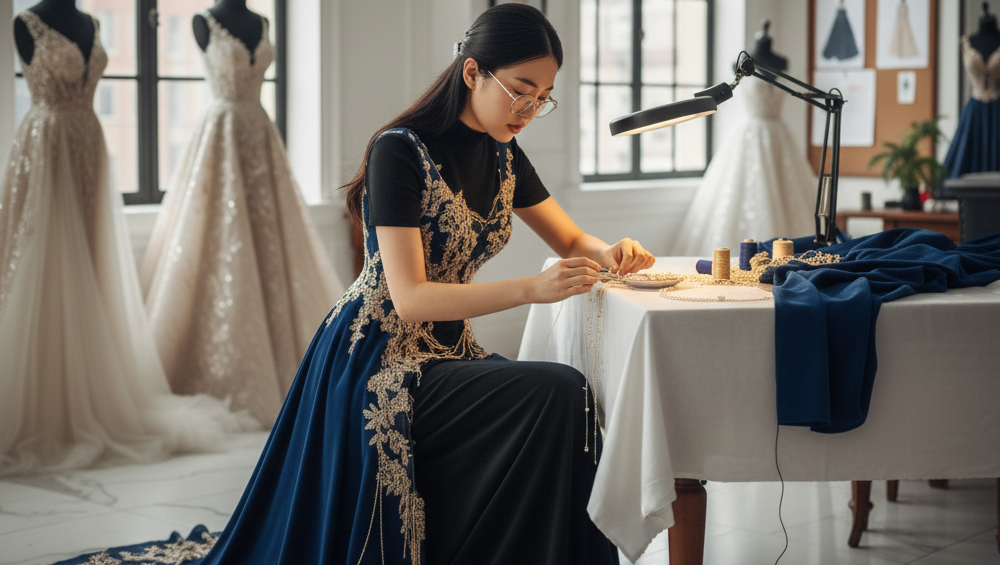
A client brought in a designer garment inherited from her grandmother for our team at Mallika ThaiDress to alter for a good fit. She intended to eventually pass this garment down to her own daughter. This job, therefore, wasn’t just an ordinary resize — it had to account for the garment’s value as an heirloom that would continue to the next generation.
Our team started by thoroughly diagnosing the garment’s condition before any decision. We found some fabric points showing wear from her grandmother’s generation, but the authentication documentation was still complete. Then, when the waist needed adjusting, our team compared possible techniques and chose the one that could be reversed, even though it took longer. And when the original buttons needed temporary removal, our team stored them systematically and photographed before and after throughout the process, along with giving the client full documentation of the alteration to keep — a clear example that preserving a garment’s value in real work isn’t a set of separate steps, but requires diagnosing, comparing technique, working carefully, and documenting evidence all at once, together.
Why Preserving Value Must Be a Continuous Process, Not Separate Steps
The concept of intangible assets (see general background on intangible asset for further reading) helps explain why a garment with heirloom meaning needs continuous care throughout the process, not just at one single point:
- A garment’s value doesn’t lie in material alone — for a garment with heirloom meaning, part of the value lies in its history and the continuity of care across generations, which is intangible but no less important than the garment itself
- Upstream diagnosis must happen before deciding on alteration — understanding the condition and factors affecting value from the start makes the next step’s technique decision more accurate
- Technique choice must connect to the diagnosis result — the technique chosen should respond to the specific factors found during diagnosis, not the same choice for every case
- Working practices and documentation must continue from technique choice — once a value-preserving technique is chosen, work and documentation must follow through consistently, or the good intent to preserve value breaks down somewhere along the way
This understanding shows that preserving the value of a garment with special meaning must be seen as a continuous process from diagnosis through to delivery, not a set of steps done separately.
How to Notice Whether Your Piece Needs the Full Value-Preservation Process
Before choosing a shop to care for a garment with special meaning, check in this sequence:
Observe whether the garment has heirloom meaning or a future passing-down plan
Consider whether this garment is intended to pass to the next generation, or holds sentimental value beyond ordinary use.
Ask whether the shop diagnoses the garment’s condition before proposing an approach
A shop with a full process usually starts with thorough diagnosis, not proposing an approach immediately without examination.
Check whether technique choice connects to the diagnosis result
Ask whether the reasoning for choosing a technique comes from the garment’s specific characteristics found during diagnosis.
Confirm you’ll receive documentation covering the whole process
Ask whether you’ll receive records spanning from diagnosis through to completion of the alteration.
When the Full Process Is Needed, and When Separate Steps Are Enough
Use this framework to assess how connected a process your work needs:
✅ Separate steps may be enough
- Simple work with no complex, multi-sided value-reducing factors
- The garment has no heirloom meaning or passing-down plan
- Full-process documentation isn’t necessary
⚠️ The full process is needed
- The work has several factors affecting value at once
- The garment holds heirloom meaning or has a future passing-down plan
- Documentation continuous from start to finish is needed
A simple rule that always applies: the more special meaning a garment holds, the more it needs a team that views the value-preservation process as one continuous whole, not just doing each step separately without connection.
What Happens When Each Step Is Viewed in Isolation
Altering a garment with special meaning while viewing each value-preservation step in isolation usually leads to inconsistent results:
- Choosing a technique without reference to the diagnosis result may not address the specific factors that garment actually has
- Careful work without continuous documentation leaves the client without complete information for the future
- Discontinuity between steps may waste the good intent to preserve value shown at the start, lost somewhere in a later step
- In the most severe cases, a garment with heirloom meaning may lose both its tangible value and its intangible meaning, if the care process lacks continuity from start to finish
“Preserving value isn’t something finished once and done — it’s something that must continue through every step.” — Mallika Thaidress
Mallika ThaiDress’s Standard for the Full Process
When taking on alteration work for a garment with special meaning or high value, our team always follows this sequence, connecting every step together:
Thoroughly diagnose condition and value-affecting factors before starting
Fully check fabric condition, documentation, and traces of previous repair, as the starting information for every following step.
Choose the technique that directly responds to the diagnosis result
Compare options and choose the technique suited to that garment’s specific factors, not the same method repeated for every case.
Work consistently to the value-preservation standard
Systematically store original components and photograph before and after throughout the process, consistent with the chosen technique.
Deliver documentation covering the whole process from start to finish
Give the client a record connecting the diagnosis result, the technique used, and full working details, as continuous evidence to keep.
Mallika Thaidress’s Decision-Making Principle
Mallika Thaidress holds that garment alteration work should not begin with the question “can this be altered?” alone, but must start by assessing “would this alteration be safe for the structure, materials, silhouette, and value of the garment?”
When the risk of an alteration outweighs its benefit, recommending against it — or pausing to assess further — is just as much a part of professional standards as carrying out the work itself.
Mallika ThaiDress’s Real-World Approach to Preserving Garment Value — Frequently Asked Questions
Why must preserving value be seen as a continuous process, not separate steps?
Because each step connects to the next: good diagnosis makes technique choice more accurate, good technique choice needs consistent work, and good work needs continuous documentation. If any link is missing, the intent to preserve value isn’t complete.
What kind of garment needs the full value-preservation process the most?
A garment with heirloom meaning, a future passing-down plan, or several factors affecting value at once usually needs the most connected process.
How do I know whether the shop I’ve chosen genuinely has a full process?
Notice whether the shop starts with diagnosis before proposing an approach, and whether they can explain how the chosen technique connects to the diagnosis result.
What should the documentation I receive cover?
It should cover the diagnosis result, the reasoning for the technique chosen, through to the details of the alteration actually carried out, so the continuity of the whole process is clear.
Does the full process cost more?
Usually slightly more since it takes more time to diagnose and document, but for a garment with special meaning, the value gained from fully preserving it usually outweighs the added cost.
Does Your Garment Hold Special Meaning
That Needs the Full Process of Care?
Send us photos for a free assessment before deciding. We diagnose, choose technique, work carefully, and document evidence continuously at every step, to fully preserve your garment’s value.
📌 Woon Khiaozen Designer
Free consultation on garment repair and alteration · We reply every day