
Why Designer Garments Must Be
Altered With Specialized Technique
A detail that looks asymmetric or unusual in a designer garment is sometimes not a flaw at all, but a deliberate design language. Altering it without understanding that intent can destroy the very thing that gives the piece its identity.
This article is part of the Expert Dress Alteration Knowledge Center. Many people assume that an unusual-looking detail in a designer garment is something that should be corrected into place. In reality, those details are sometimes not flaws at all, but a deliberate design language the designer built in to communicate a specific identity. Altering it without understanding that intent can unknowingly destroy what gives the piece its value. This article explains why altering designer garments requires understanding the designer’s intent, not just sewing skill.
When Intentional Asymmetry Nearly Got Corrected Into Symmetry
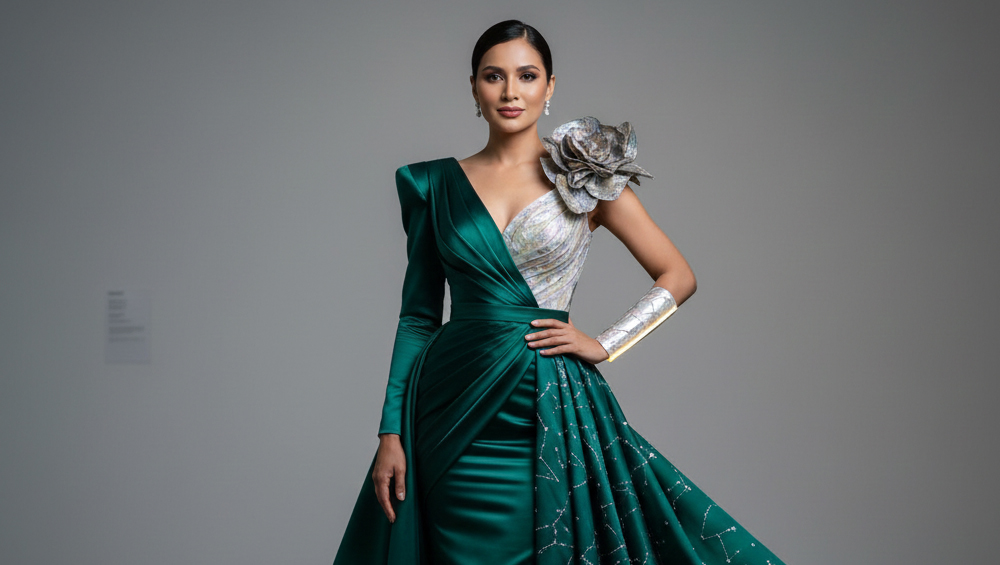
A client brought in a designer dress with an asymmetric draped panel across the waist, wanting a size adjustment. She had previously requested a quote from another shop, which offered to balance the asymmetry evenly on both sides during the size adjustment, explaining it would make the dress “look tidier.”
When our team at Mallika ThaiDress examined it, we found that the asymmetry of this draped panel wasn’t a manufacturing flaw at all, but a deliberate design line built to draw the eye to a specific point on the body — a signature feature of that particular collection. Balancing it as the other shop proposed would have completely destroyed the design line at the heart of the piece. Our team adjusted the size while precisely preserving the original proportion and angle of the draped panel, even though this required significantly more complex technique than simply making it symmetric — a clear example that altering a designer garment must start by understanding which details are the designer’s intent, rather than judging by eye what should be corrected to “look tidier.”
Why Details in Designer Garments Are Usually Intentional, Not Flaws
The concept of a fashion designer (see general background on fashion designer for further reading) helps explain why details in high-end designer garments often reflect a designer’s specific intent:
- Asymmetry or a specific placement is usually a design line — designers often use asymmetry, a specific dart placement, or the angle of a draped panel to communicate a collection’s identity, not as a result of a manufacturing flaw
- Looseness or tension that looks imperfect may be intentional — a designer sometimes deliberately gives certain points looser or tighter fabric than others, to create specific movement or weight when worn
- Altering without distinguishing intent from flaw can destroy the garment’s identity — judging by eye that a detail “looks untidy” and correcting it immediately can unknowingly destroy what is the designer’s signature
- Distinguishing intent from flaw requires understanding design language — whoever alters the garment needs a basic knowledge of design technique, to assess whether a found detail is the designer’s intent or a genuine problem worth fixing
This understanding shows that altering a designer garment isn’t just about adjusting size for a better fit — it must start with reading and understanding the piece’s design language before deciding which points to touch and which to preserve.
How to Distinguish Whether a Found Detail Is the Designer’s Intent
Before deciding to alter a point that looks unusual in a designer garment, check in this sequence:
Observe whether the detail appears consistently or looks like an isolated mistake
An intentional detail usually has internal consistency, unlike a flaw, which usually looks out of step with the overall structure.
Check whether the detail relates logically to other parts of the garment’s structure
Observe whether the unusual-looking point connects to another design line or structural element in a reasonable way.
Ask about or research the collection or brand
If possible, check whether the brand or designer used this kind of design signature in other collections too.
Have a specialist assess before deciding to correct it
Never decide by eye alone that an asymmetric or unusual-looking point should be corrected — always have a specialist who understands design language assess it first.
When to Preserve the Original Detail, and When It’s Genuinely a Flaw Worth Fixing
Use this framework to distinguish between a designer’s intent and a genuine flaw:
✅ Usually the designer’s intent — should be preserved
- The detail appears consistently and connects logically to other structural elements
- A similar characteristic appears in other pieces from the same collection or brand
- The seams and stitching in that area are neat, with no sign of a mistake
⚠️ May genuinely be a flaw worth fixing
- The detail looks inconsistent with the garment’s overall structure
- A loose seam or unsystematic abnormality is visible
- No similar characteristic appears in other pieces from the same collection
A simple rule that always applies: when unsure whether a detail is intent or flaw, always assume it’s intent and preserve it until there’s clear evidence it’s genuinely a flaw — because an alteration that destroys a designer’s intent usually can’t be undone.
What Happens When a Designer Garment Is Altered Without Understanding the Designer’s Intent
Correcting a detail intended as a signature feature, mistaking it for a flaw, usually leads to a result that’s hard to undo:
- The garment may permanently lose the identity that was the designer’s signature, even when the overall size fits better as requested
- A design line adjusted into symmetry or “tidiness” usually can’t be returned to its original form, since it would require rebuilding the whole piece
- The garment’s value as a piece of collection-specific design may drop significantly if the signature detail is destroyed
- In the most severe cases, an alteration that misunderstood the designer’s intent may leave the garment no different from ordinary clothing, when its original value came from being a piece of specialized design
“What looks imperfect is sometimes exactly what the designer intended to be perfect.” — Mallika Thaidress
Mallika ThaiDress’s Standard for Reading Design Language
When taking on an alteration job for a designer garment, our team always follows this sequence:
Survey the whole garment to identify details that may be intentional
Examine every point that looks asymmetric or unusual, before planning an alteration approach.
Analyze the relationship between that detail and the overall structure
Assess whether the found detail connects logically to other design lines elsewhere on the garment.
Explain to the client before proposing an approach
Show the client which point is likely the designer’s intent, and explain why it should be preserved.
Adjust size or alter while precisely preserving the original proportion of that detail
Use technique that preserves the angle and proportion of the original design line, even when it takes more time and precision than making it symmetric.
Mallika Thaidress’s Decision-Making Principle
Mallika Thaidress holds that garment alteration work should not begin with the question “can this be altered?” alone, but must start by assessing “would this alteration be safe for the structure, materials, silhouette, and value of the garment?”
When the risk of an alteration outweighs its benefit, recommending against it — or pausing to assess further — is just as much a part of professional standards as carrying out the work itself.
Why Designer Garments Must Be Altered With Specialized Technique — Frequently Asked Questions
Is an asymmetric-looking detail in a designer garment always a flaw?
Not always. In many cases, asymmetry is a design line the designer intentionally created to communicate a collection’s identity. Have a specialist examine it before deciding whether it’s genuinely a flaw.
If I’m not sure whether a detail is intentional, what should I do?
Assume it’s intentional and consult a specialist before deciding to alter it, since an alteration that destroys a designer’s intent usually can’t be undone.
Does preserving a designer’s intentional detail increase the cost?
Usually higher than an ordinary symmetric adjustment, since it requires more complex, precise technique to preserve the original proportion and angle of the design line accurately.
How do I know whether the shop I’ve chosen understands the difference between intent and flaw?
A shop with genuine understanding can usually explain why a detail is likely the designer’s intent, and proposes an approach that preserves the original design line, rather than offering to symmetrize it immediately without explanation.
If an intentional detail was already destroyed by a previous alteration, can it still be restored?
It depends on the degree of damage to the original structure. In some cases a specialist can analyze and partially restore the original design line, but each case should be examined and assessed individually, since some types of damage may only be partially correctable.
Have a Designer Garment That Needs
Altering Without Destroying Its Identity?
Send us photos for a free assessment before deciding. We always read your garment’s design language first, to preserve the designer’s intent in full.
📌 Woon Khiaozen Designer
Free consultation on garment repair and alteration · We reply every day
1 Comments on “Why Designer Garments Require Specialized Alteration Techniques”
Comments are closed.