

Risk Factors When Altering
Designer Brand Garments
Risk in altering designer brand garments isn’t limited to sewing skill alone. Some risk comes from the material itself being irreplaceable — and must be identified before work begins, not after a problem occurs.
This article is part of the knowledge cluster under How Altering Designer Brand Garments Differs From General Alteration Shops. Earlier articles covered material differences and the specific techniques required; this one brings together the risk factors that should be identified before alteration begins — because some risk doesn’t come from sewing skill alone, but from the nature of the material itself, which cannot be undone if a mistake occurs.
When the Genuine Risk Wasn’t in Skill, but in the Material Itself
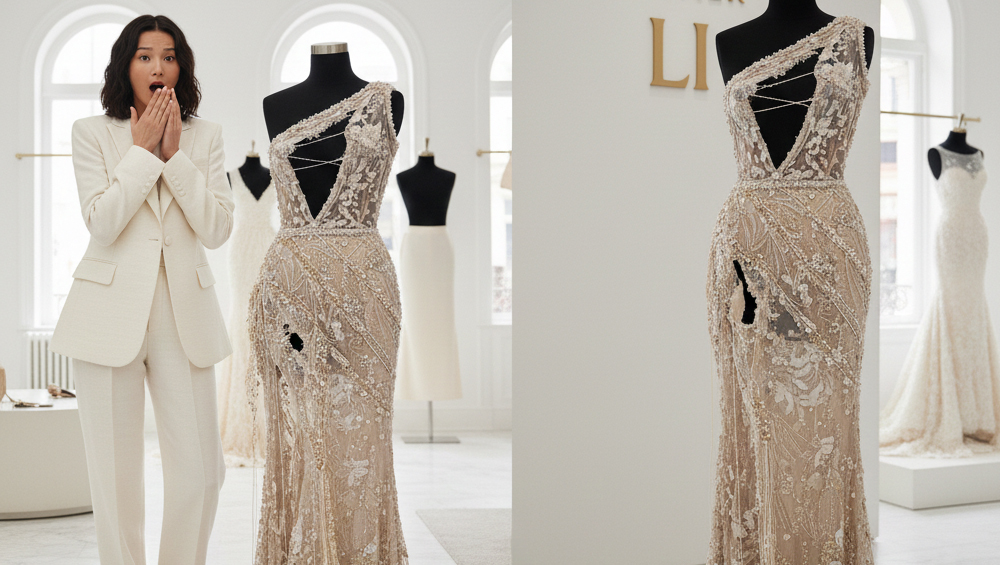
A client brought in an older designer piece decorated with a pattern specific to one particular collection, wanting a size adjustment. Before starting any work, our team at Mallika ThaiDress found that the decorative material at the point needing alteration had been discontinued and was no longer available from any source in the market.
Our team explained to the client honestly: even though skill and technique were sufficient for this alteration, the genuine risk didn’t lie in the sewing itself. If even a small mistake occurred with this decorative material during the alteration, there would be absolutely no way to find a replacement identical to the original. Our team proposed that the client consider an alternative approach that didn’t directly affect this area, even though the result wouldn’t fully match the original request — a clear example that identifying the genuine risk factor requires looking beyond the question “is there enough skill to do this?” to also ask “if a mistake happens, can it be undone?” — a question that must be answered before work begins, not after a problem occurs.
Categories of Risk Factors in Altering Designer Brand Garments
The concept of risk assessment (see general background on risk assessment for further reading) helps categorize risk factors commonly found when altering designer brand garments:
- Risk from irreplaceable material — certain lace, fabric, or decorative material has been discontinued or belongs to a specific collection; if damaged during alteration, there’s no way to find an identical replacement at all
- Risk from unfamiliar brand-specific construction — each brand may use specific construction techniques outside general standards; unfamiliarity with this specific structure increases the risk of unknowingly altering it incorrectly
- Risk from the fragility of decorative work — hand embroidery, beading, or special patterns are usually more fragile than ordinary fabric structure, making the risk of damage higher than ordinary alteration work
- Risk to resale value or authentication — for certain designer brand pieces, an unsuitable alteration may affect resale value or future authentication of the piece — a risk dimension that doesn’t exist for ordinary clothing
This understanding shows that assessing risk in altering designer brand garments must consider every dimension, not just the dimension of sewing skill alone.
How to Identify Risk Factors Before Deciding to Alter
Before deciding to proceed with altering a designer brand garment, check in this sequence:
Ask whether the material at the point to be altered can still be replaced
Check whether the lace, fabric, or decorative material there is still manufactured, or belongs to a discontinued collection.
Have a specialist honestly assess their familiarity with that brand’s specific structure
Ask whether the specialist has encountered this kind of structure before, to assess the risk from unfamiliarity.
Assess how fragile the decorative work is at the point to be altered
Observe whether the hand-embroidered work or beading in that area is in an especially fragile condition.
Ask the most important question before deciding: if a mistake happens, can it be undone?
No matter how good the skill, always ask this question before starting, since it reveals the genuine level of risk.
When Risk Sits at an Acceptable Level, and When to Pause for Alternatives
Use this framework to assess risk level before deciding to proceed:
✅ Risk sits at an acceptable level
- Material at the point to be altered can still be replaced if damaged
- The specialist is familiar with this kind of structure already
- Decorative work in that area isn’t especially fragile
⚠️ Should pause and consider alternatives
- Material at the point to be altered is discontinued or has no replacement source
- Unfamiliar brand-specific structure with uncertain outcome
- Decorative work is in an especially fragile condition
- The piece carries high value, both for resale and personal meaning
A simple rule that always applies: whenever potential damage cannot be undone at all, always consider an alternative approach, no matter how skilled the specialist is — because the genuine risk lies in the nature of the material, not in skill.
What Happens When Risk Factors Aren’t Identified Before Work Begins
Starting an alteration without assessing every dimension of risk usually leads to results that cannot be undone:
- If an irreplaceable material is damaged during alteration, that damage stays with the piece permanently, with no way to reverse it
- Altering without familiarity with a brand’s specific structure may lead to unexpected mistakes, even if the specialist has strong skill in ordinary work
- Fragile decorative work, once damaged, usually can’t be repaired back to its original state completely
- In the most severe cases, a piece’s value — both in price and personal meaning — may be lost permanently, from an alteration that didn’t assess risk thoroughly from the start
“The most important question isn’t whether it can be done — it’s whether it can be undone if it goes wrong.” — Mallika Thaidress
Mallika ThaiDress’s Standard for Risk Assessment
Before taking on an alteration job for a designer brand garment, our team always follows this sequence:
Check whether the material at the point to be altered can be replaced
Identify whether that material is still manufactured, or belongs to a discontinued collection, before assessing overall risk.
Honestly assess familiarity with the piece’s specific structure
Openly acknowledge unfamiliarity with this kind of structure if that’s the case, rather than guessing and risking proceeding anyway.
Communicate risk found to the client honestly
Explain clearly to the client what the genuine risk is, even if it means recommending against the client’s original request.
Offer an alternative approach when risk is too high to accept
If potential damage can’t be undone, propose another approach that doesn’t directly affect the risky area, rather than forcing through the original request.
Mallika Thaidress’s Decision-Making Principle
Mallika Thaidress holds that garment alteration work should not begin with the question “can this be altered?” alone, but must start by assessing “would this alteration be safe for the structure, materials, silhouette, and value of the garment?”
When the risk of an alteration outweighs its benefit, recommending against it — or pausing to assess further — is just as much a part of professional standards as carrying out the work itself.
Risk Factors When Altering Designer Brand Garments — Frequently Asked Questions
Why isn’t risk in altering designer brand garments only about sewing skill?
Because some risk comes from the nature of the material itself — such as discontinued material with no replacement source. No matter how skilled the specialist, if that material is damaged, there’s simply no way to undo it.
What should I ask before deciding to alter a designer garment with special material?
Ask whether the material at the point to be altered can still be replaced, and ask the most important question: if a mistake happens during alteration, can it be restored to its original state?
If a specialist isn’t familiar with that brand’s specific structure, what should happen?
A responsible specialist should acknowledge unfamiliarity honestly, and may recommend further examination or a small-area test first, rather than proceeding without confidence.
Does every designer brand garment always carry the risk of irreplaceable material?
Not always — it depends on whether the material belongs to a standard product line still manufactured, or a discontinued specific collection. Check on a piece-by-piece basis before deciding.
If risk is too high to accept, are there still other options?
In many cases a specialist can propose an approach that doesn’t directly affect the risky area, even if the result won’t fully match the original request, helping keep the piece safe from damage that cannot be undone.
Not Sure Whether Altering Your
Designer Garment Carries Risk?
Send us photos for a free assessment before deciding. We identify every dimension of risk honestly, before recommending the safest approach for you.
📌 Woon Khiaozen Designer
Free consultation on garment repair and alteration · We reply every day
1 Comments on “Risk Factors in Altering Branded Fashion Garments”
Comments are closed.