

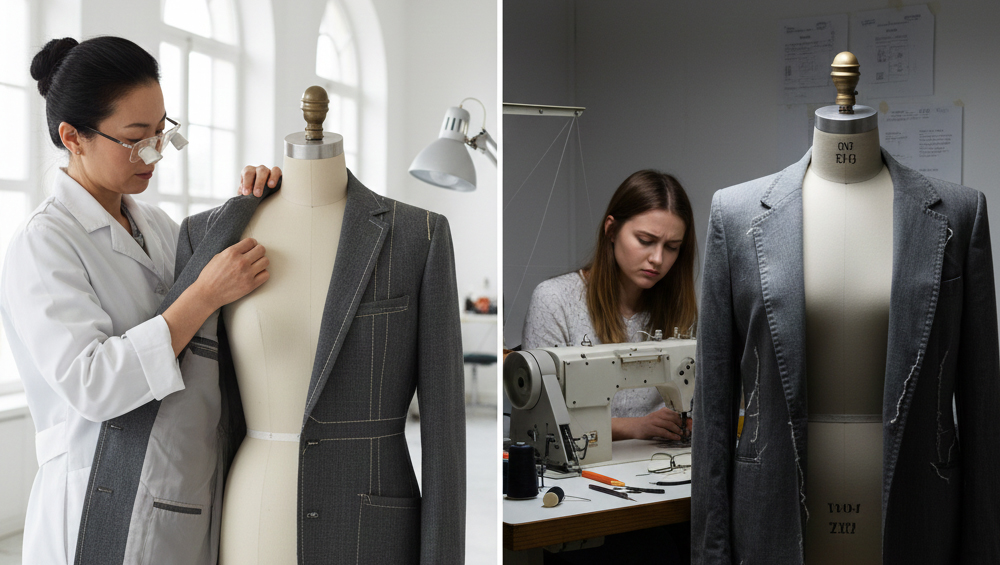
Designer Garment Structure
vs Ordinary Work
The complex internal structure of a designer garment usually isn’t unnecessary complication — it’s structural engineering designed to support that garment’s specific silhouette. Reducing it without understanding its function can leave the garment losing the shape it was built for.
This article is part of the knowledge cluster under Why Designer Garments Must Be Altered With Specialized Technique. The parent article covered how unusual-looking details in designer garments are often a deliberate design language; this one looks at the difference in internal structure between designer garments and ordinary work — because structure that looks complex usually isn’t unnecessary complication, but engineering designed to support that specific garment’s silhouette.
When a Structure That Looked Overcomplicated Turned Out to Be What Held the Garment’s Shape
A client brought in a designer evening gown, wanting the internal reinforcement structure simplified. Comparing it to other dresses she’d seen, she felt this garment’s structure was more complex than necessary, and thought reducing it would make it more comfortable to wear without affecting the outward appearance.
When our team at Mallika ThaiDress examined the internal structure thoroughly, we found that the reinforcement placement that looked unnecessary was actually a critical load-bearing point holding up this particular garment’s specific silhouette. Reducing it as the client wanted would have thrown off the balance of the shape the garment was designed for, causing it to collapse when worn. Our team explained the function of each structural point to the client, and proposed keeping the main structure while adjusting only the points that didn’t affect load-bearing, to increase wearing comfort — a clear example that structure which looks complex in a designer garment usually isn’t unnecessary complication, but structural engineering with a specific function, which must be understood before deciding to reduce or alter it.
The Difference in Internal Structure Between Designer Garments and Ordinary Work
The concept of structural engineering (see general background on structural engineering for further reading) helps frame why the internal structure of designer garments differs significantly from ordinary work:
- Designer garments usually have specific load-bearing points designed for a specific silhouette — the placement of reinforcement structure, boning, or reinforced lining layers is calculated to support each garment’s specific shape, not placed in the same standard position on every piece
- Ordinary work usually uses simpler, ready-made structure — for the convenience of mass production, ordinary clothing usually uses a standard reinforcement structure that works across many designs, not engineered specifically for any one silhouette
- Structural complexity relates to the complexity of the desired silhouette — the more distinctive a garment’s shape, the more complex the supporting internal structure usually needs to be, since it must distribute and bear weight at precise points
- Reducing structure without understanding its function can throw off the shape’s balance — without knowing which point is the primary load-bearing one, reducing or altering it may leave the garment losing shape when actually worn, even when it looks normal lying flat
This understanding shows that a designer garment’s internal structure should be considered as engineering with a specific function, not complication that can be compared directly against the simplicity of ordinary work.
How to Check Whether a Found Structure Has a Load-Bearing Function
Before deciding to reduce or alter the internal structure of a designer garment, check in this sequence:
Try the garment on to observe how the structure affects the shape
A garment’s shape when worn differs greatly from when lying flat. Observe whether each structural point affects the garment’s stability while being worn.
Check the position of reinforcement structure against points that need to bear weight
Observe whether the found structure sits in a position related to the part of the body that needs to bear the fabric’s weight.
Compare against the structure of other pieces in the same collection, if possible
If you have a chance to compare with other pieces from the same collection, it helps confirm whether this structure is a standard pattern used by the designer.
Have a specialist assess before deciding to reduce it
Never decide to reduce structure just because it looks more complex than what you’re used to — always have a specialist assess its function first.
When to Preserve the Original Structure, and When It Can Be Adjusted Safely
Use this framework to assess whether a found structure should be preserved or can be adjusted:
✅ May be adjusted safely
- The structure at that point isn’t in the garment’s primary load-bearing path
- The adjustment doesn’t affect the garment’s shape when actually worn
- Confirmed to be a supplementary structure that doesn’t affect the primary shape
⚠️ Should preserve the original structure
- The structure at that point relates to the garment’s primary load-bearing position
- A similar characteristic appears in other pieces from the same collection
- Trying it on reveals the structure clearly affects the garment’s shape
A simple rule that always applies: when unsure whether a structural point has a load-bearing function, always assume it does and preserve it until it’s clearly proven adjustable without affecting shape — because reducing structure that’s load-bearing at the wrong point usually can’t be easily undone.
What Happens When Structure Is Reduced Without Understanding Its Function
Reducing or altering internal structure while misunderstanding it as unnecessary complication usually leads to results that are hard to detect at first:
- The garment’s shape may lose its balance when actually worn, even when it looks normal lying flat or hanging
- Points that once shared load-bearing may need to carry more when a neighboring point is reduced, causing damage in other areas afterward
- When shape imbalance is found after wearing, the whole structure may need to be unpicked and rebuilt, costing more time and expense than analyzing function before deciding
- In the most severe cases, the garment’s distinctive silhouette may be permanently lost, if the reduced structure can’t be fully rebuilt to match the original
“What looks overcomplicated is sometimes what keeps the garment standing.” — Mallika Thaidress
Mallika ThaiDress’s Standard for Structural Analysis
When a client wants to reduce or adjust the internal structure of a designer garment, our team always follows this sequence:
Analyze the load-bearing path of the whole structure first
Check how each structural point connects to the garment’s shape-bearing function, before considering the client’s request.
Have the client try it on to observe the structure’s real effect
Let the client see for themselves how each structural point affects the garment’s shape while being worn, not just explain it verbally.
Explain the function of each structural point so the client understands
Point out which points are primary load-bearing and should be preserved, and which can be adjusted without affecting shape.
Propose an option that increases comfort without affecting the primary load-bearing points
If the client wants more comfort, adjust only the points that don’t affect the primary structure, rather than reducing the whole system.
Mallika Thaidress’s Decision-Making Principle
Mallika Thaidress holds that garment alteration work should not begin with the question “can this be altered?” alone, but must start by assessing “would this alteration be safe for the structure, materials, silhouette, and value of the garment?”
When the risk of an alteration outweighs its benefit, recommending against it — or pausing to assess further — is just as much a part of professional standards as carrying out the work itself.
Designer Garment Structure vs Ordinary Work — Frequently Asked Questions
Why does the internal structure of a designer garment look more complex than ordinary work?
Because designer garments usually have a specific silhouette that needs load-bearing at precise points. The internal structure is designed specifically for that shape, unlike ordinary work, which usually uses a standard structure that works across many designs for manufacturing convenience.
If I want a garment to be more comfortable, do I always need to reduce the structure?
Not always. In many cases, only points that don’t affect the primary structure can be adjusted to add comfort, without reducing the whole load-bearing system. Have a specialist assess before deciding.
How do I know which structural point is a primary load-bearing one?
A specialist should check by having you try the garment on, since a garment’s shape when worn differs greatly from lying flat. Assessing from a photo or a flat lay alone usually isn’t enough.
Does every designer garment always have this kind of complex structure?
Not always — it depends on the complexity of the shape the designer wanted. A garment with a simple silhouette may not need particularly complex reinforcement structure. Check on a piece-by-piece basis.
If a structure was already reduced and the shape was lost, can it still be restored?
It depends on the degree of damage to the original structure. In some cases a specialist can analyze and build a replacement structure that performs a similar function, but each case should be examined and assessed individually.
Want to Adjust a Designer Garment’s
Structure Without Losing Its Shape?
Send us photos for a free assessment before deciding. We always analyze the load-bearing path of the structure first, to preserve your garment’s specific shape in full.
📌 Woon Khiaozen Designer
Free consultation on garment repair and alteration · We reply every day