

Specialized Techniques for
Designer Brand Work and Special Materials
Each special material — beading, sequins, or delicate sheer fabric — needs a different specific technique. Using the same approach on every material usually leads to preventable damage.
This article is part of the knowledge cluster under How Altering Designer Brand Garments Differs From General Alteration Shops. The previous article covered the broad differences between designer brand garments and ordinary clothing; this one looks at the specific techniques used to handle each type of special material — because each special material needs a different approach, and no single technique works for every material.
When Taking In One Seam Meant Removing Hundreds of Beads First
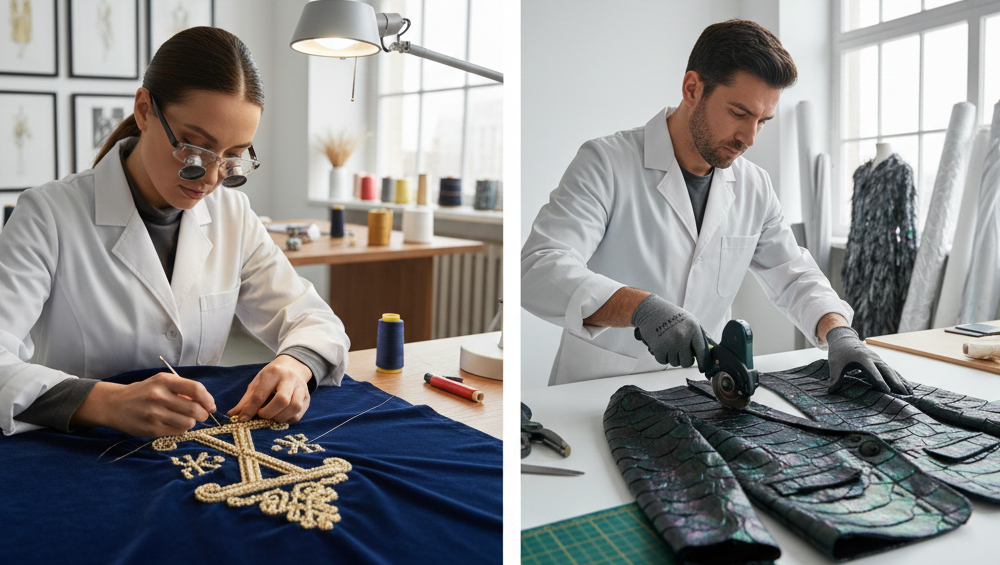
A client brought in a designer evening gown with dense beading along the entire side seam, wanting the seam taken in slightly for a closer fit. Sewing directly over the seam using an ordinary technique risked cracking or dislodging the beads sitting along that line, and would leave the beading pattern discontinuous after the alteration.
Our team at Mallika ThaiDress chose an entirely different approach — starting by carefully removing the beads one by one along the section of seam that needed altering, then taking in the fabric seam to the required size, and finally hand-sewing the beads back into place so the pattern matched seamlessly. The whole process took several times longer than an ordinary seam alteration, but the result was a closer-fitting seam with not a single bead damaged, and a beading pattern that continued as beautifully as if it had never been touched — a clear example that each special material needs a technique entirely different from ordinary alteration work, and understanding the correct technique for each material is what separates professional-level alteration from ordinary work.
Why Each Special Material Needs a Different Technique
The concept of beadwork (see general background on beadwork for further reading) helps illustrate one example of why each special material needs a different handling approach:
- Beading and sequin work needs removal and hand-reattachment — sewing directly over beads or sequins usually cracks or dislodges them, so they must be removed before the seam is altered, then reattached to continue the pattern seamlessly
- Delicate sheer fabric needs a different seam and fabric-handling approach — fabrics like chiffon or organza need specific seam techniques to prevent fraying or tearing, unlike the standard seams used for thicker fabric
- Metallic or specialty thread embroidery needs careful attention to tension — metallic thread is usually more brittle and breaks more easily than ordinary thread; sewing near this area requires adjusting thread tension and sewing speed appropriately
- Hand-embroidered lace needs precise pattern-matching — when cutting or joining hand-embroidered lace, the pattern must be matched precisely to continue seamlessly, unlike machine-made lace, which has a consistently repeating pattern that’s easier to join
This understanding shows that altering a garment with special materials isn’t just about knowing basic sewing technique — it requires a library of specific techniques for each material type, and knowing which technique applies when.
How to Identify What Special Materials Your Dress Has
Before asking for advice or deciding to proceed with alterations, check in this sequence:
Notice whether the point you want altered has beading, sequins, or embroidery
Check whether the seam or area to be altered is decorated with beads, sequins, or embroidery thread, since these points always need special technique.
Check whether the fabric is delicate and sheer
Observe whether the fabric is transparent or unusually thin, since this type of fabric needs specific seam and handling technique to prevent fraying or tearing.
Notice whether the lace is hand-embroidered with a non-repeating pattern
If the lace has a naturally irregular pattern, joining or cutting it will need more care than machine-made lace with a repeating pattern.
Have a specialist assess all materials before determining an approach
If more than one special material is found on the same piece, have a specialist assess the whole picture first, to plan a technique appropriate to every point.
When Specialized Technique Is Needed, and When Standard Technique Works
Use this framework to assess whether the point to be altered needs specialized technique:
✅ Standard technique may be enough
- The point being altered has no beading, sequins, or embroidered decoration
- The fabric is standard-weight, not unusually thin or sheer
- The lace used is machine-made with a consistently repeating pattern
⚠️ Specialized technique is needed
- The point being altered has beading, sequins, or specialty thread embroidery
- The fabric is delicate and sheer, such as chiffon or organza
- The lace is hand-embroidered with a non-repeating pattern
- More than one special material sits in the same area
A simple rule that always applies: whenever even a single point of special material is found in an area to be altered, always use the technique specific to that material, rather than using standard technique and hoping there won’t be a problem.
What Happens When Standard Technique Is Used on Special Material
Using standard sewing technique on material that needs specific care usually leads to preventable damage:
- Beads or sequins sewn directly over usually crack or dislodge, and identical replacement pieces aren’t always available in every case
- Delicate sheer fabric altered with a standard seam may fray or tear along the seam line, requiring re-alteration or fabric replacement that may have no original source to purchase from
- Metallic thread sewn with unsuitable tension usually breaks or degrades faster than it should, permanently damaging the embroidered pattern
- In the most severe cases, mismatched hand-embroidered lace joining may require unpicking and re-repairing the entire area, costing more time and expense than using the correct technique from the start
“Each special material has its own technical language.” — Mallika Thaidress
Mallika ThaiDress’s Library of Specialized Techniques
When special material is found on a garment brought in for alteration, our team always follows this sequence:
Identify every type of special material in the area to be altered
Check for beading, sequins, delicate fabric, or hand-embroidered lace, before selecting a technique to use.
Remove or protect decorative elements before altering the fabric structure
For beading or sequins, carefully remove them before altering the seam, to prevent damage from the needle and thread’s pressure.
Select seam technique and thread tension specific to that material
Adapt technique to suit delicate fabric or specialty thread, rather than using the same standard setting for every job.
Reattach decorative elements so the pattern continues seamlessly
Once the structural alteration is finished, hand-sew beads or sequins back into place so the pattern continues without leaving a visible trace of the alteration.
Mallika Thaidress’s Decision-Making Principle
Mallika Thaidress holds that garment alteration work should not begin with the question “can this be altered?” alone, but must start by assessing “would this alteration be safe for the structure, materials, silhouette, and value of the garment?”
When the risk of an alteration outweighs its benefit, recommending against it — or pausing to assess further — is just as much a part of professional standards as carrying out the work itself.
Specialized Techniques for Designer Brand Work and Special Materials — Frequently Asked Questions
Why does altering a seam with beading take so much longer than an ordinary seam?
Because the beads must be removed one by one before the seam is altered, to prevent them from cracking or dislodging from the needle and thread’s pressure, then hand-sewn back in place so the pattern continues seamlessly — a detailed process that takes several times longer than an ordinary seam.
If some beads or sequins go missing during alteration, can they always be replaced?
Not always — it depends on whether that bead or sequin material is still manufactured or available. A specialized team usually tries to remove and preserve the original pieces as much as possible to reduce this risk.
What kind of seam does chiffon or organza specifically need?
Usually a seam technique that finishes the edge neatly to prevent fraying, with lighter thread tension than usual to avoid puckering or tearing the fabric. This should be handled by a specialist experienced with this fabric type.
How do I know whether the shop I’ve chosen genuinely has specific technique for special materials?
A shop with genuine expertise can usually explain clearly how they’ll handle beading, sequins, or delicate fabric, and usually asks in-depth questions about materials before taking on the job, rather than agreeing immediately without examination.
If my dress has several special materials at once, how should I prepare before alteration?
Have a specialist examine all the materials on the same piece first, to plan a sequence and technique appropriate for every point, rather than altering each spot separately without the full picture.
Does Your Dress Have Beading,
Sequins, or Special Material?
Send us photos for a free assessment before deciding. We identify every special material and choose the appropriate technique to preserve the pattern and value of the piece.
📌 Woon Khiaozen Designer
Free consultation on garment repair and alteration · We reply every day