

Vintage Beadwork Repair for Red Evening Gown
at Mallika Thaidress, Bangkok
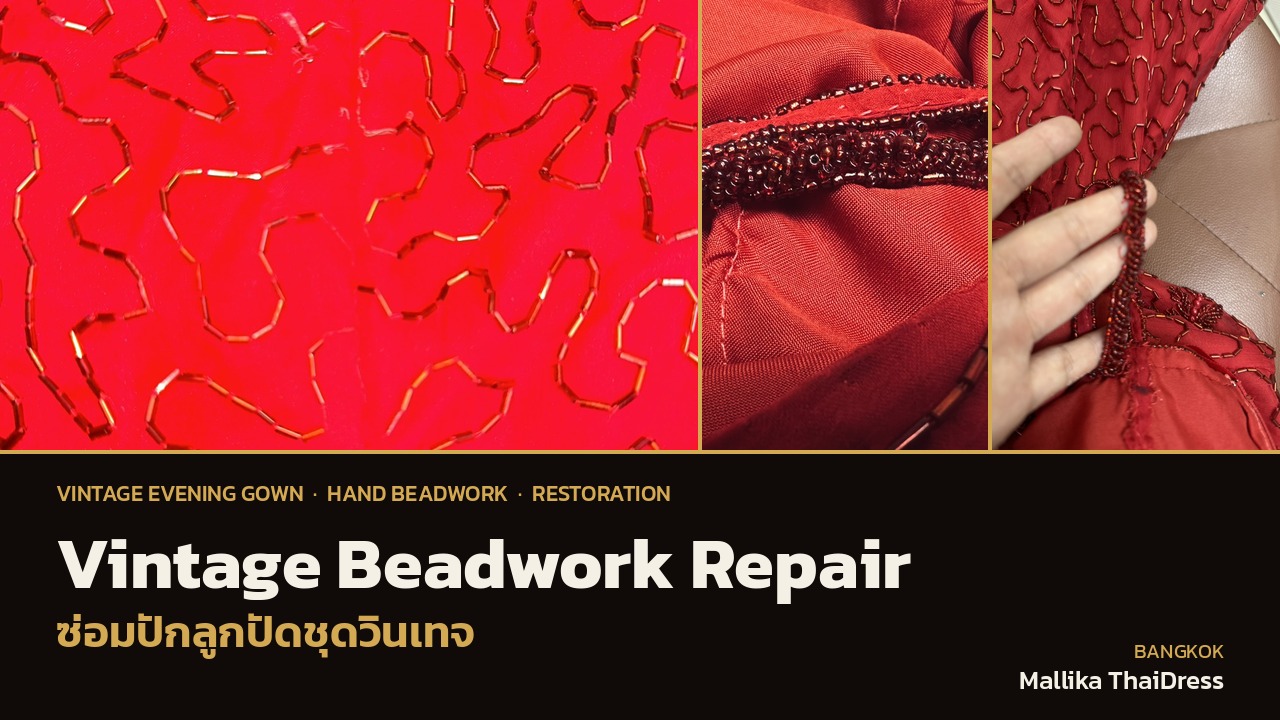
Red mesh fabric with wavy-line bugle bead embroidery in deep red to copper tones, round bead knitted borders — each bead re-stitched by hand to match the original pattern
A red mesh evening gown decorated with hand-beaded embroidery is among the most intricate pieces a seamstress can encounter. Each bugle bead is arranged in flowing wavy lines across the entire garment, while round beads are closely knitted along the collar and hem. When thread deteriorates or beads come loose, the repair must be carried out entirely by hand to preserve the continuity of the original design.
At Mallika Thaidress, we do not make new garments. We specialise exclusively in the repair and restoration of existing pieces — to return a cherished gown to wearable condition.
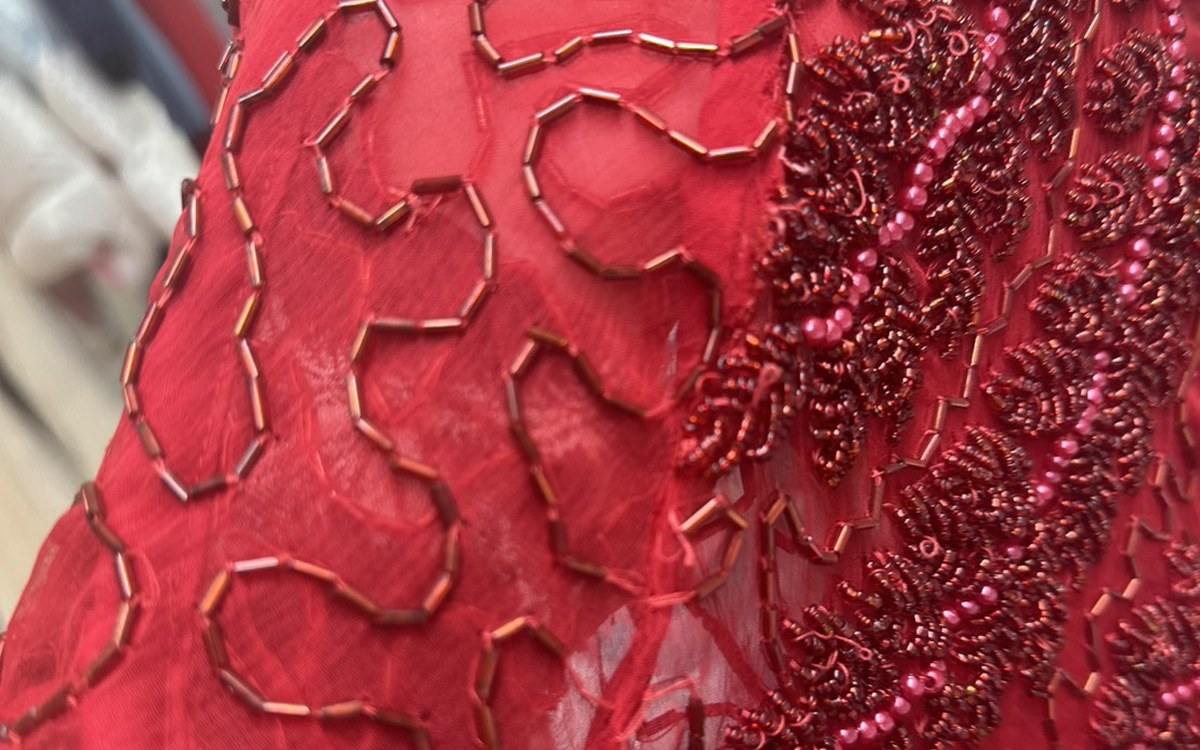
The red mesh fabric is embroidered with bugle beads in deep red to copper tones, arranged in wavy flowing lines across the cloth. The collar and border areas feature rows of closely knitted round beads. The lining inside is vivid red. Work of this nature requires meticulous hand repair and careful attention at every stage.
Why Beadwork Garments Require Specialist Repair
Each bead is threaded onto the fabric with individual stitches. Over time, or with frequent wear, the thread may deteriorate or break, causing beads to fall away. If the repair is done incorrectly, or if replacement beads do not match the originals in colour or size, the pattern will appear broken and the repair will be visible.
Mesh fabric has open gaps throughout. Re-threading beads requires following the original thread path precisely so the fabric does not stretch or distort. Replacement bugle beads must match the originals as closely as possible in colour, size, and surface finish so that the repaired section blends seamlessly with the rest.
Condition Assessment — Planning Every Point Before Work Begins
Before any repair begins, the garment is inspected thoroughly — both on the outer fabric and inside the lining — to identify every area where beads have come loose or thread has deteriorated, including the round bead borders at the collar and hem. The order of repair is then planned to ensure the pattern remains consistent throughout.
Bugle Beads on Mesh
Repaired by hand; replacement beads are matched as closely as possible to the originals and re-threaded along the original pattern path.
Knitted Round Bead Border
Border areas where beads have come loose or thread has broken are repaired so the knitted row is firm and even throughout.
Red Lining Inside
The lining and any stitching related to the beadwork are inspected to ensure the garment’s structure remains sound after repair.
Preserving the Original Design
The pattern is never altered, and beads are never added where none have come loose. Only the areas that require repair are worked on.
The Repair Process — Step by Step
Both the outer fabric and lining are examined to identify every area where beads have come loose or thread has deteriorated. Any bugle beads that have fallen away are collected and kept on the workbench for use in the repair.
As a general practice, we select replacement bugle beads in deep red that match the originals as closely as possible in colour and size, so the repaired section blends naturally with the rest of the pattern.
One hand is slipped beneath the layers of red mesh fabric near the knitted round bead border to hold the cloth at the right tension at the point of repair, while the other hand holds the needle and thread.
Deep red bugle beads are re-stitched one at a time along the wavy line of the original pattern. This work is done entirely by hand and takes time.
As a general practice, all repaired areas are reviewed to confirm that the wavy bead pattern is continuous and that the knitted round bead border is even and consistent throughout.
After the Repair — What Clients Should Know
The outcome of beadwork repair depends on the condition of the fabric and original thread in each individual garment. Where the fabric remains strong and the beads have come loose in accessible areas, the repair can usually match the original pattern closely. Where the thread has deteriorated significantly or the mesh has become fragile, further assessment may be needed. We will advise on the actual condition and the approach to repair after inspecting the garment in person.
Limits of the Work and How to Decide Before Repair
Material limits: The result of bead repair depends on the condition of each garment. Brittle mesh, heavily worn original thread, or beads that are hard to match in colour and size can mean some spots cannot be restored exactly as before. The shop explains what can be repaired, based on the actual condition, before starting. For more on materials, see Rare or Delicate Materials: Why Consult First.
What we do not do: We do not add beads in areas that are not damaged and we do not change the original pattern, because unnecessary work can change the character of the garment and be hard to undo (see Irreversible Alterations). For a garment its owner is attached to, keeping the original pattern matters as much as strength — read more in Clothing and Emotional Value: Why Some Garments Are Irreplaceable.
How to decide: In general, we separate spots that can be repaired individually from areas where the fabric or thread has worn widely enough to need extra planning, then explain the options so the owner can decide. If you are unsure how your garment should be repaired, you can send photos for a preliminary assessment (Send Photos for Expert Assessment Before Alteration) or read the criteria in When to Consult an Expert Before Altering. An assessment from photos is not an inspection of the real garment; the shop will confirm the condition and the suitable approach after examining it in person.
Frequently Asked Questions
Does Mallika Thaidress repair beadwork on evening gowns?
Yes. We accept repairs and restoration of existing garments, including beadwork, deteriorated thread, and areas where beads have come loose. Each bead is re-stitched by hand to match the original pattern. Please note that we do not make new garments.
How difficult is it to repair beadwork on this type of evening gown?
Gowns with bugle beads arranged in wavy lines on mesh fabric, and with round bead borders, require meticulous hand repair. The original thread path must be followed, the closest-matching beads selected, and the direction of the pattern maintained for a seamless result.
How long does beadwork repair take?
The time required depends on the number of areas to be repaired and the complexity of the pattern. We will assess the garment in person and advise on the timeframe before any work begins.
Do I need to book an appointment, or can I simply bring the gown in?
We recommend getting in touch first via Messenger, LINE OA, or by calling 062-639-6195 to arrange a convenient time. The shop is open Monday–Saturday, 12:00–24:00 (closed Sundays).

Woon Khiaozen
Specialist in garment structural analysis and precision alteration engineering, with over 33 years of experience with international luxury brands. Trusted by clients from Thailand and abroad for Down Jacket, Tailored Suit, and Technical Outerwear work.
Read full profile →References and Expert Guidance on Textile Conservation
Leading textile conservation institutions share several consistent recommendations: (1) Store flat, not on a hanger — heavily beaded garments should not be hung for extended periods, as the weight of the beads will gradually strain the fabric and seams. Store in a box lined with acid-free tissue paper, folded as little as possible. (2) Keep any fallen beads with the garment — if beads come loose before the garment is brought in for repair, place them in a small bag and keep them with the gown so the repairer can match them exactly. (3) Support the garment from beneath before moving it — always support the full weight of a beaded gown from below before lifting it; gripping it at a single point may cause thread to break under the weight of the beads.
-
Canadian Conservation Institute — CCI Notes 6/4: Care of Objects Decorated with Glass Beads ↗
Advises examining beadwork for loose beads before moving, supporting from below with a rigid board, storing flat rather than hanging, keeping any detached beads with the object, and provides guidance on securing loose thread and beads.
-
Canadian Conservation Institute — Basic care: Textiles ↗
Recommends against hanging heavily beaded garments; minor repairs should be done by hand-sewing using appropriate thread and backing fabric, with stitches kept loose and existing thread avoided where possible.
-
Canadian Conservation Institute — CCI Notes 13/2: Flat Storage for Textiles ↗
Recommends flat storage for heavily decorated garments such as beaded gowns — fold as little as possible and pad any folds with acid-free tissue paper.
-
Victoria and Albert Museum — Caring for vintage wedding dresses & veils ↗
Advises storing in an acid-free box, avoiding prolonged hanging which puts stress on seams, and notes that a skilled dressmaker can carry out alterations on garments in good condition.
-
Australian War Memorial — Conservation advice: Textiles ↗
Advises against hanging beaded or heavily embroidered garments on thin straps or sheer fabric, as the weight will cause damage over time. Store in a box lined with acid-free tissue paper.